
Some exhibitions are meant to be seen once. Others linger—etched into memory long after the walls come down. Zessei belongs firmly to the latter.

Now streaming via STARTO ENTERTAINMENT’s “FAMILY CLUB online” streaming service, the Zessei Launch Commemorative Photo Exhibition AFTER MOVIE allows the project to come alive once more—this time beyond the physical confines of Tokyo. Available to viewers worldwide until January 31, the video offers two parallel experiences at once: a return for those who walked through the exhibition in person, and an open door for those who could not—particularly international fans who have so far only encountered Zessei through posted pages and photographs online.
Even without English subtitles, the meaning carries through. The Juniors themselves have proven again and again that expression, presence, and sincerity travel easily across language. This AFTER MOVIE understands that. It does not rush to explain. Instead, it lets atmosphere, conversation, and intent speak for themselves.
The video begins quietly, with editor-in-chief Tadayoshi Ohkura (hereinafter referred to as Ohkura) arriving at the venue alongside ACEes’ Ryusei Fukada and Kansai Junior Takuya Nishimura on the day before the exhibition opens. The press conference has just ended, and the space is still unseen by the two Juniors. There is no performance here—only first impressions.
At the entrance, room 0, we are met not with images, but with words. The text speaks of memory and emotion carried across time—of redefining the value of touch in an age of accelerating digital consumption. It describes the texture of paper felt through one’s fingertips, the scent of ink, and the quiet exhilaration of turning a page. Digital data, it argues, is consumed instantly and disappears just as easily, while analog presence remains—deeply engraving memory and feeling, capturing fleeting moments and carrying them forward into the future as something that can be kept.
Ohkura describes this passage as the true beginning of Zessei: a declaration of how the project wishes to exist, and how it hopes to be received. In a world moving rapidly toward convenience and ephemerality, it is a deliberate insistence on materiality—on pages meant to be returned to, touched, and remembered.
“Everything about this exhibition begins with these words,” Ohkura explains as they oversee the text. It is a fitting opening not only for the exhibition itself, but for Zessei as a whole—an origin point. For some, this magazine will be a first encounter with the Juniors. For others, it will be the first magazine they choose to hold onto, to keep, to return to. In that sense, Zessei does not simply document a moment; it quietly becomes the beginning of many different journeys.
The first room opens into a wall dedicated to the title Zessei and its logo design. Several drafts are displayed side by side, proposals that explored ways to make the letter “Z” visually striking as Ohkura searched for a form that could carry his intent. The meaning of the title itself is stated clearly: to photograph the Juniors who take center stage—Generation Z idols—through “peerless visuals,” zessei in every sense.
Ohkura explains that once this idea was conveyed, the decision came instantly. Both the title and the logo were chosen without hesitation, guided not by extended deliberation but by first impression.

But it is the structure of the logo that lingers longest. When asked about the mirrored “se / es” lettering, Ohkura explains that it was designed to feel reflective—like looking into a mirror. Facing and seeing oneself—being seen.
It is a small detail, easily overlooked. And yet, it quietly defines the entire project. Zessei is not just about presenting idols to an audience, but about the moment when subject and image meet—when a person confronts how they are framed, remembered, and understood.
From there, the video moves into the second introductory space—room 2 Alternate Cuts—a room filled with photographs that never made it to print. More than 200 alternate cuts line the walls. Ohkura speaks candidly about the reality of magazine production: hundreds of images are taken, yet only a fraction survives editorial selection.
What determined inclusion here was not perfection alone, but tension—images that matched an idol’s established image, and images that challenged it. Expressions that felt familiar, and others that revealed something entirely new. In giving these photographs space, the exhibition reveals the invisible labor of judgment: what it means to choose, and what it means to let go.

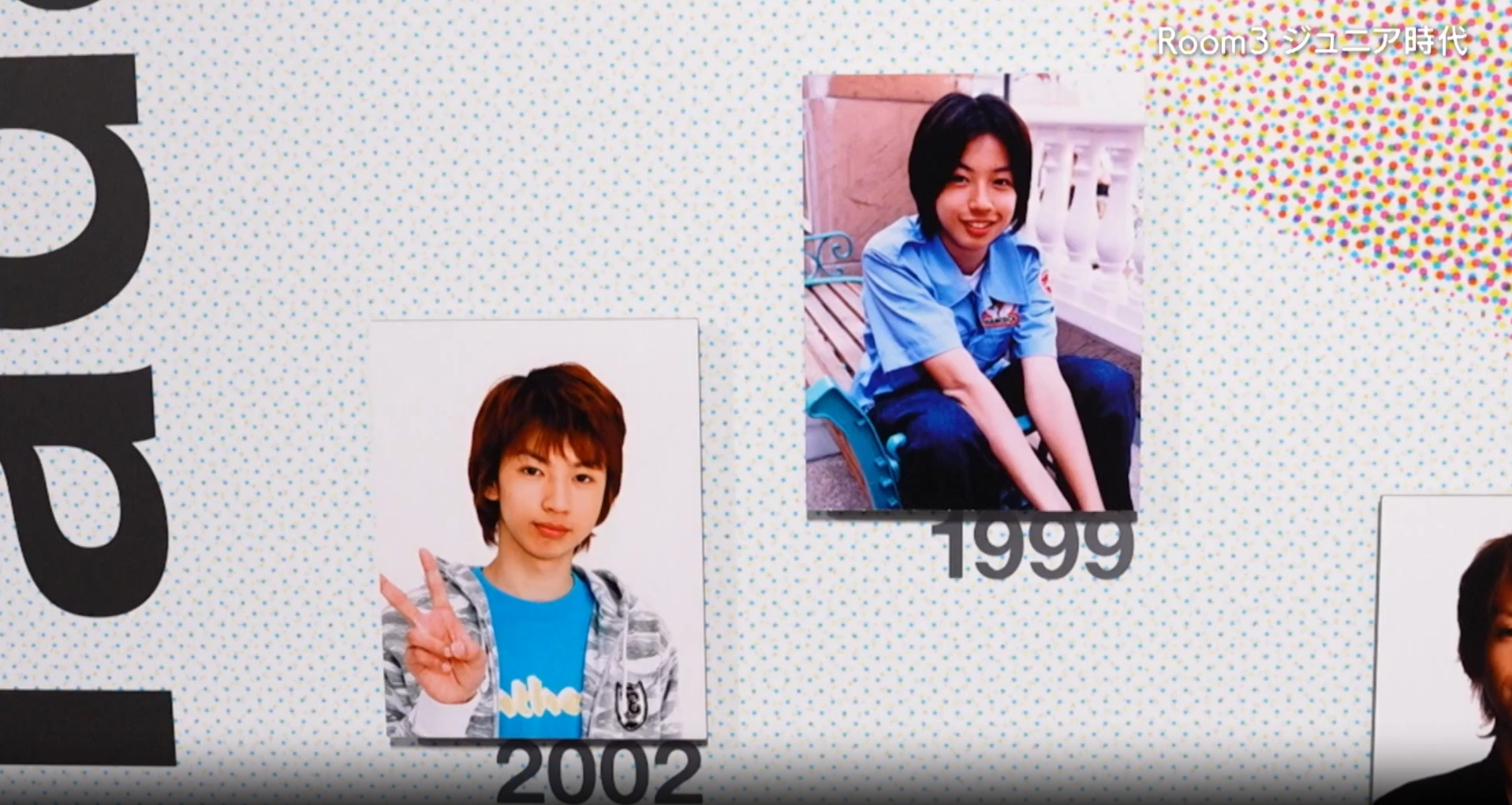
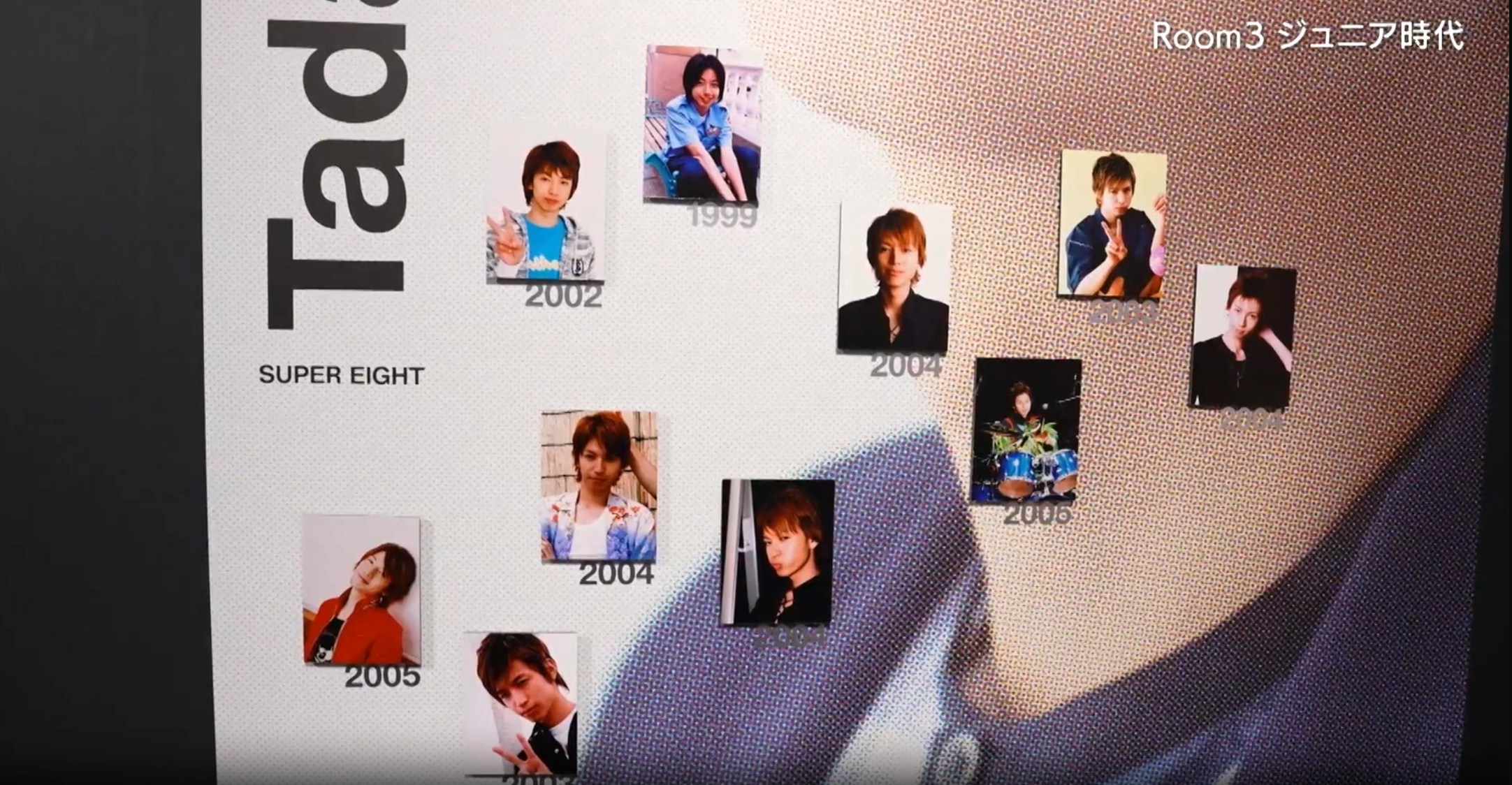
The third room, titled Our History, traces Junior history across generations. Alongside current Juniors are photographs of the senior artists who participated in Zessei’s inaugural issue—Fuma Kikuchi (timelesz), Daigo Nishihata (Naniwa Danshi), Yoshinori Masakado (Ae! group), Ren Nagase (King & Prince), and Shunsuke Michieda (Naniwa Danshi)—during their own Junior days, including Ohkura himself. He reacts with visible embarrassment, joking about image quality and time, but the meaning is clear. This is not nostalgia for its own sake. It is continuity.
Ohkura pauses to explain that this space is built around the fundamentals of print itself—the color structure used to create magazines. Rather than digital RGB, it draws on CMYK (cyan, magenta, yellow, and black), the base of all printed matter. The room visualizes this process by enlarging the concept of a magazine page, breaking color down into its components.
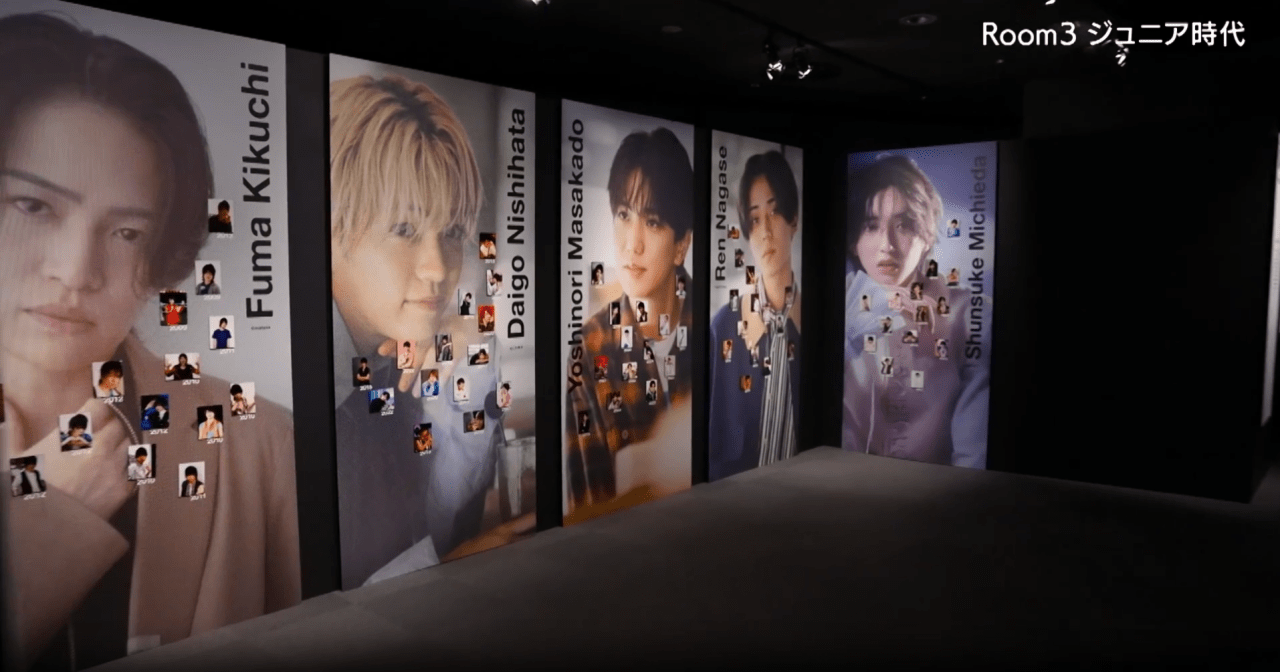
Seen from a distance, the huge images of the senior artists appear clear and unified. As you move closer, those images begin to blur, allowing older photographs of them on the wall to come in focus instead. It is a physical demonstration of how print works—and why it matters. In an age where most images exist only as backlit data, this room quietly reminds viewers that magazines are designed to be held, viewed at different distances, and experienced with the body as much as the eyes. Here, Zessei situates today’s Juniors within a much longer lineage—one shaped by repetition, uncertainty, and gradual self-awareness. The room quietly insists that no debut is sudden, and no presence appears fully formed.
The fourth room, From the Inside, turns inward. Instead of images, it presents words: each talent’s self-identified “Zessei appeal point.” Visitors are invited to guess which response belongs to whom before peeking inside.
Ohkura explains that while the idea of the structure came from the planners, the content itself—the questions and answers—was carefully considered. The result is playful, but revealing. Confidence and insecurity sit side by side. Humor becomes honesty. It is a reminder that Zessei was never meant to be beauty without voice.
The heart of the exhibition follows in the fifth room, Beautiful Forest, often referred to as the Zessei space itself because the contents are like treasures found in a forest. Here, photographs selected even more rigorously from those featured in the magazine are displayed across angled panels, with mirrored surfaces placed behind them. The result is a dreamlike, immersive environment—one where visitors search for their oshi while being surrounded by reflections, depth, and scale, experiencing the world of Zessei with an almost overwhelming sense of presence.
This area was also designated as a photography-permitted zone. Visitors were encouraged not only to photograph their favorite images, but to take photos with them—to stand alongside the visuals, to record the encounter, and to carry that memory forward. It is a space where Zessei, conceived as a magazine meant to be held and revisited, intentionally opens itself to being shared digitally as well—allowing the physical and the virtual to coexist without contradiction.
When Ryusei is asked about which photo was his favorite from the magazine, he speaks highly of a spread of Shunsuke. He reflects on atmosphere—on the difficult-to-name quality that the Naniwa Danshi member possesses. As he speaks, he recalls that shoot he did with Shunsuke—watching from the side as that presence unfolded in real time. “His aura was unreal,” he reflects. There was a fragility to it, an atmosphere so striking it lingered in the air. “It was insane. Truly Zessei.”
It is not technique he describes, but feeling. Something seen, absorbed, and quietly aspired to. He speaks of watching closely, trying to take even a fragment of it in. That kind of presence, he admits, is probably incredibly difficult to create—but it is something he studied, held onto, and thought about long after. Someday, he hopes, he might carry that same quiet weight himself.
When asked what mattered most to him as editor-in-chief, Ohkura does not speak about concepts or visuals first. He speaks about people. About making sure everyone could participate comfortably, keeping stress to a minimum, and creating an atmosphere where, even mid‑shoot, the talent could think: “Oh, they’re capturing me like this,” “This looks beautiful.” For Ohkura, that sense of reassurance—of being seen and treated with care—was essential to the act of photographing itself.
The journey in the after movie ends at the message wall, where visitors once left handwritten notes in their chosen colors—perhaps matching the member color of their oshi, and we get to see a glimpse of how it looked during the event itself.
Even here, Ohkura hesitates to place himself at the center. When persuaded to add his own photo and message to the board of photos, it is simple, modest, almost shy. The restraint feels consistent. Throughout the video, despite being the architect of Zessei, he repeatedly redirects attention toward the Juniors—their comfort, their confidence, their ability to feel proud of what is being created around them.
When asked about the future and goals of Zessei, Ohkura resists defining it too clearly. There are still Juniors who have yet to be featured, he says, and for that reason, he does not want to lock Zessei into any single identity or fixed idea of what kind of magazine it should be. Instead, he wants the theme to change each time—to remain fluid. More than anything, he wants Zessei to be a magazine that makes the Juniors think, “I want to be in it,” and, once they have been, “I want to be in it again.”
That philosophy—of reflection, selectivity, and care—is what the AFTER MOVIE ultimately preserves. Not just what Zessei looks like, but why it exists.
For those who were there, it is a return. For those who weren’t, it is an invitation.
The Zessei Exhibition AFTER MOVIE is now streaming worldwide via FAMILY CLUB online (for Japanese residents and for overseas viewers) until January 31, for 500 yen. The inaugural issue of Zessei is also available for global purchase through FAMILY CLUB.STORE GLOBAL.
©STARTO/JPL/MCo, Inc.