
If there is one thing that defines the current era of King & Prince, it is their ability to reinvent the concept of showmanship. With “Theater“ music video release, Ren and Kaito open the doors to a stage where funk, precision dance, and a “cinematic” aesthetic blend to perfection. Following the success of tracks like “moooove!!“, this new release arrives to reaffirm their artistic maturity just ahead of their highly anticipated dome tour. In Dumpling Box to celebrate that the video has already reached three million views, we see this as the perfect chance to analyze every frame and note of this production, which is already becoming a major talking point across Tiara, social media, and among critics alike!
“Theater,“ positions itself not only as a musical release but as a sophisticated piece of visual art that celebrates the magic of cinema. With a narrative that blurs the line between reality and fiction, the duo pays explicit tribute to major box-office hits, turning their MV into a “mirror game” with Hollywood. From the very first second, “Theater” immerses us in a nostalgic and grand atmosphere. The video is not just a simple choreography on a bright set; it is a journey through the history of cinema, where Kaito and Ren act as the protagonists of their own fictions. The premise is clear: life and art meet in a movie theater, and King & Prince are the directors of this sensory experience! The central concept of the MV is the theater as an emotional refuge; the artistic direction uses a saturated color palette and dramatic lighting to differentiate the worlds that the protagonists visit. Visually, the meticulous recreation of iconic scenes stands out, functioning as anchors of nostalgia for the viewer.
Musically, “Theater“ moves away from aggressive electronic sounds to embrace a pop style with strong influences of Funk and 90s R&B. The rhythm section features a very prominent bassline that invites constant movement and evoke the “golden era” of pop. A vocal maturity is noticeable in the duo; The harmonies in the chorus are rich and convey a sense of celebration and the use of English phrases like “Welcome to our theater” reinforces the international and theatrical theme of the track. Regarding the structure, the song builds gradually. After a more melodic bridge, the ending explodes into a “Show time” section that feels like the grand finale of a Broadway musical.
A Museum of Hollywood References
The most fascinating aspect of this MV is its production design, which pays tribute to several iconic Hollywood films, this can be seen in both the most insignificant and the most notable details. These are just some references that we have been able to point out of such an incredible production, but we will be delighted if you let us know how many you have been able to find!
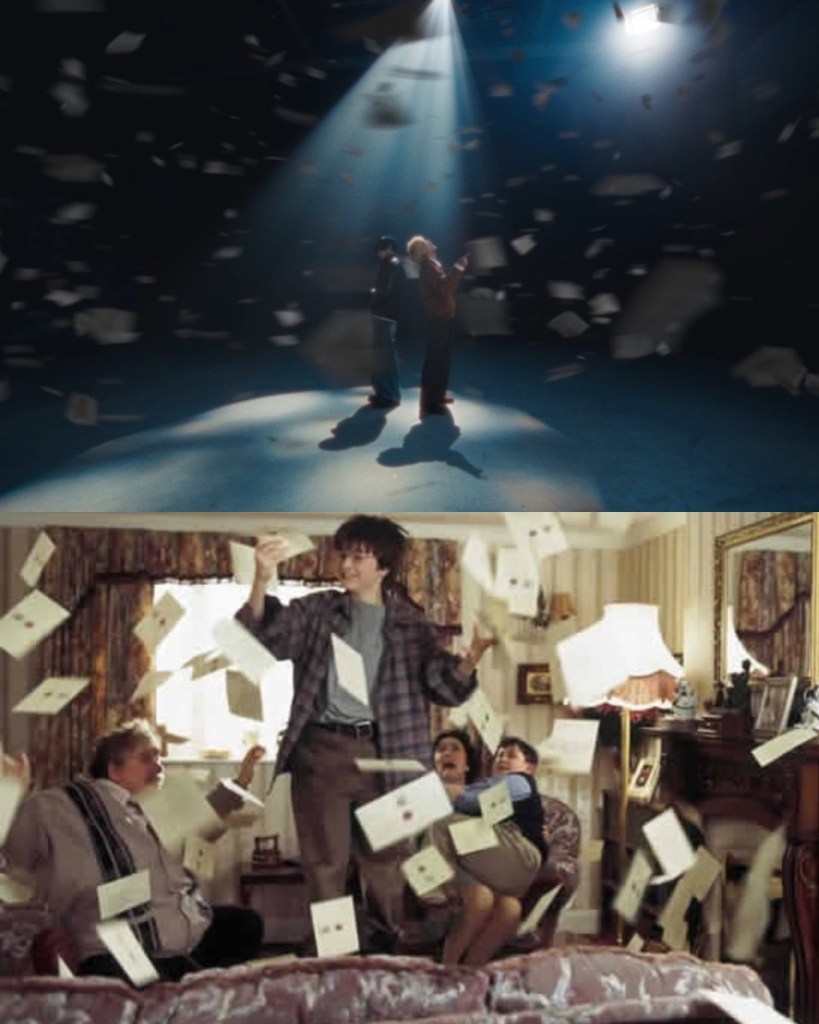
“Harry Potter”: The video captures the magical essence of the saga. A specific scene shows Kaito and Ren under a whirlwind of floating letters, a clear allusion to the iconic rain of Hogwarts letters that floods the Dursleys‘ house in The Sorcerer’s Stone.
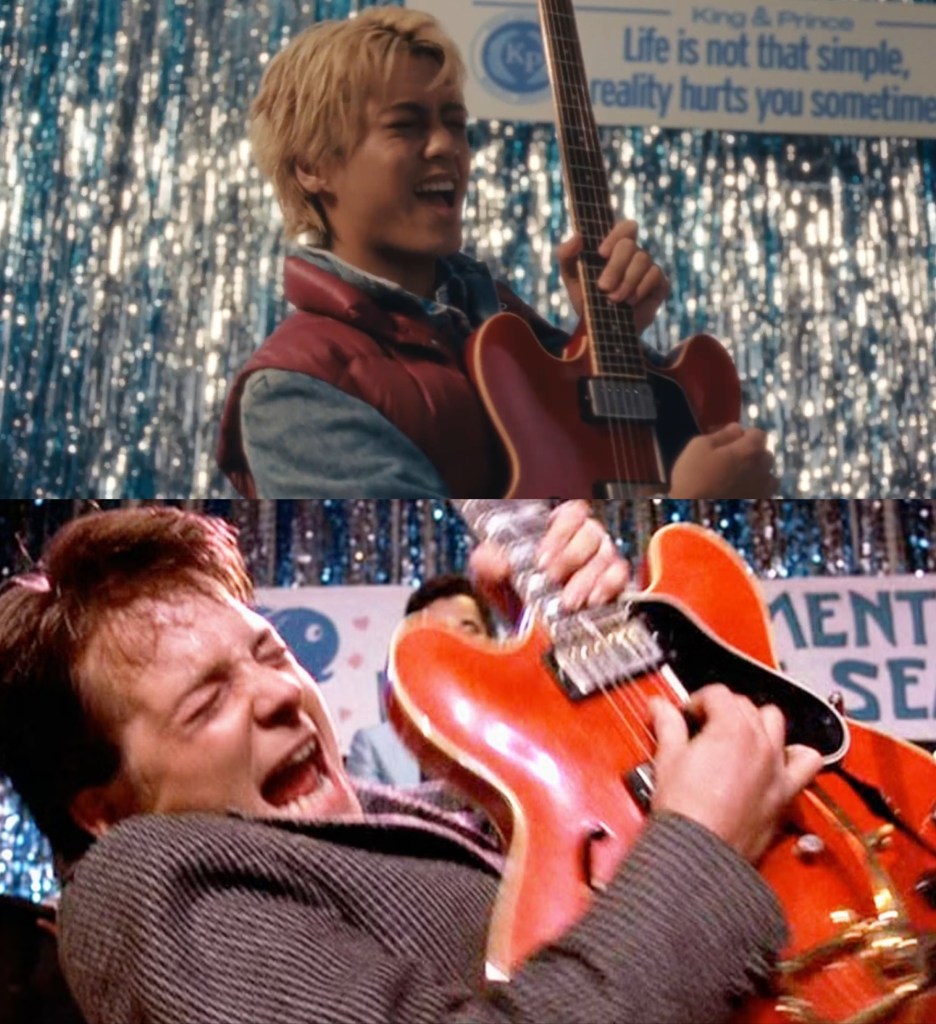
“Back to the Future” : In one of the most dynamic sequences, Kaito emulates Marty McFly during the prom dance. The image shows the artist with a red electric guitar and the characteristic orange quilted vest, replicating the energy and expression of Michael J. Fox at the climax of his performance of “Johnny B. Goode“.
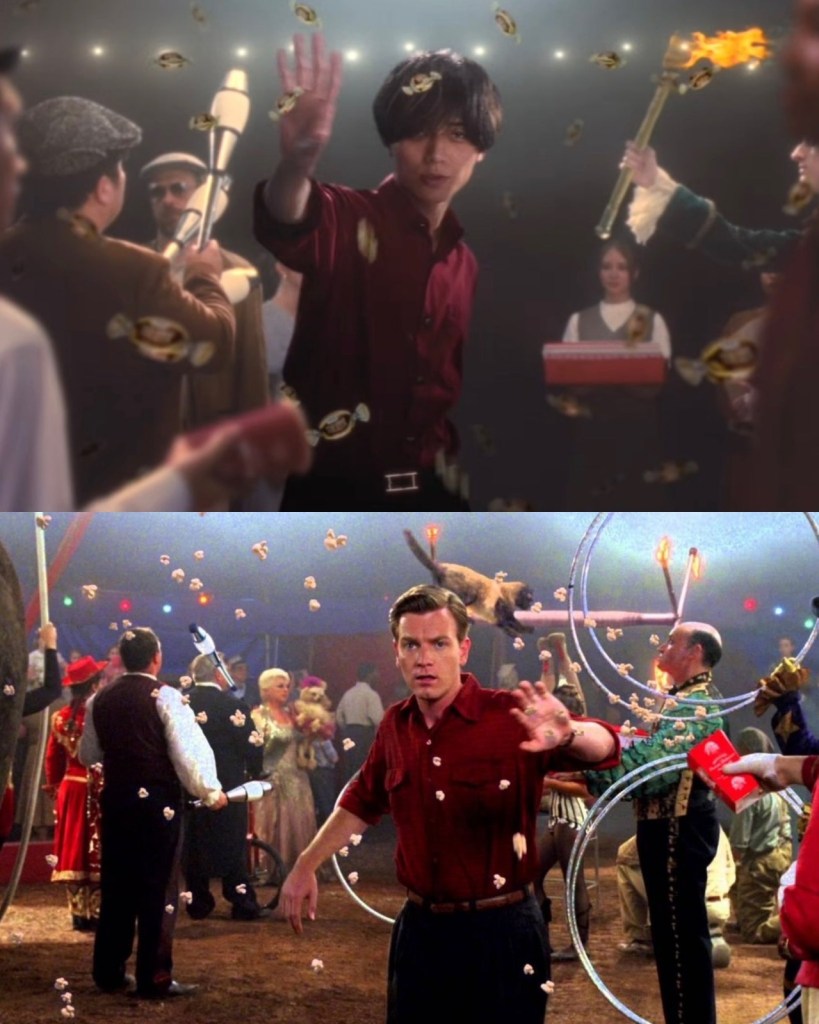
Big Fish: King & Prince recreate the magical moment when time stops in a circus. Much like Ewan McGregor’s character, one of the members is seen surrounded by objects suspended in the air (in this case, sweets and popcorn), capturing that sense of love at first sight and temporal suspension characteristic of Tim Burton’s film.
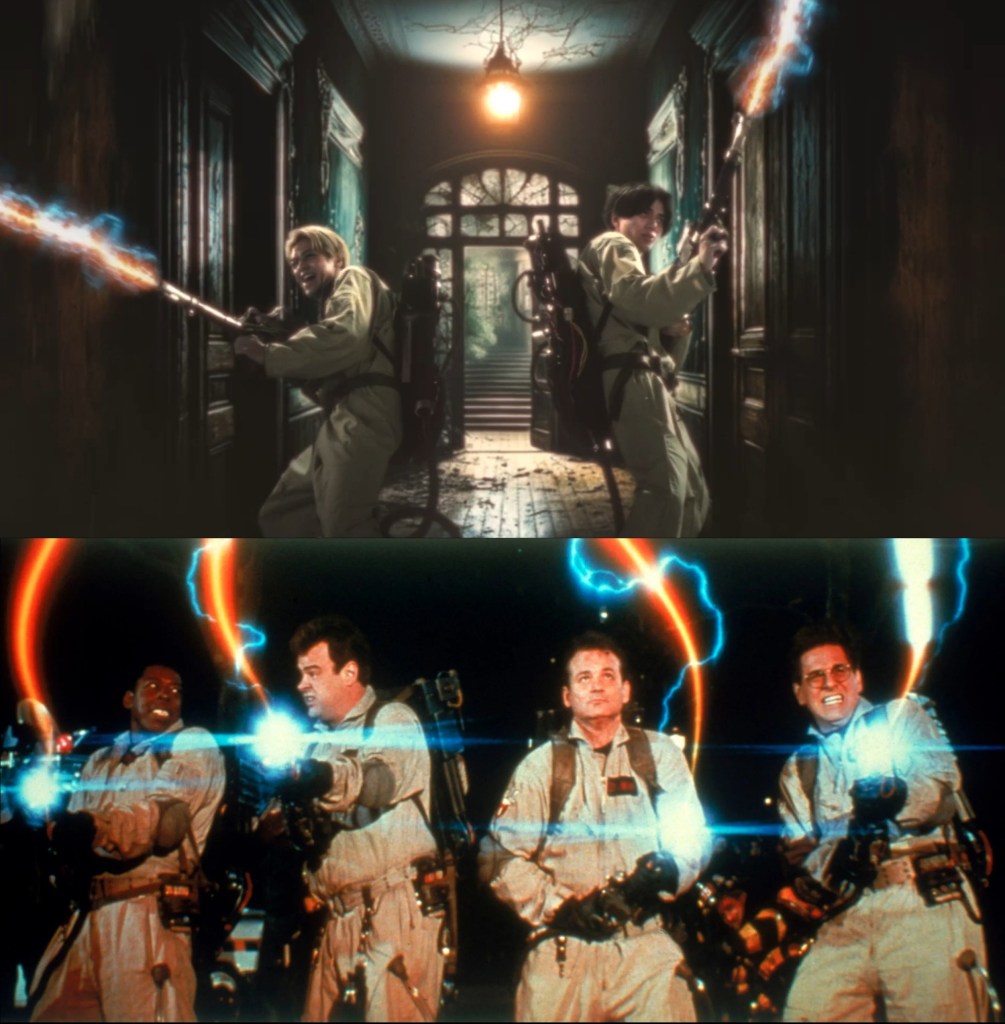
“Ghostbusters”: The duo dons the classic jumpsuits and uses “proton packs” to fire energy beams in a dark hallway, an exact replica of the aesthetics and special effects of the 80s science fiction comedy.
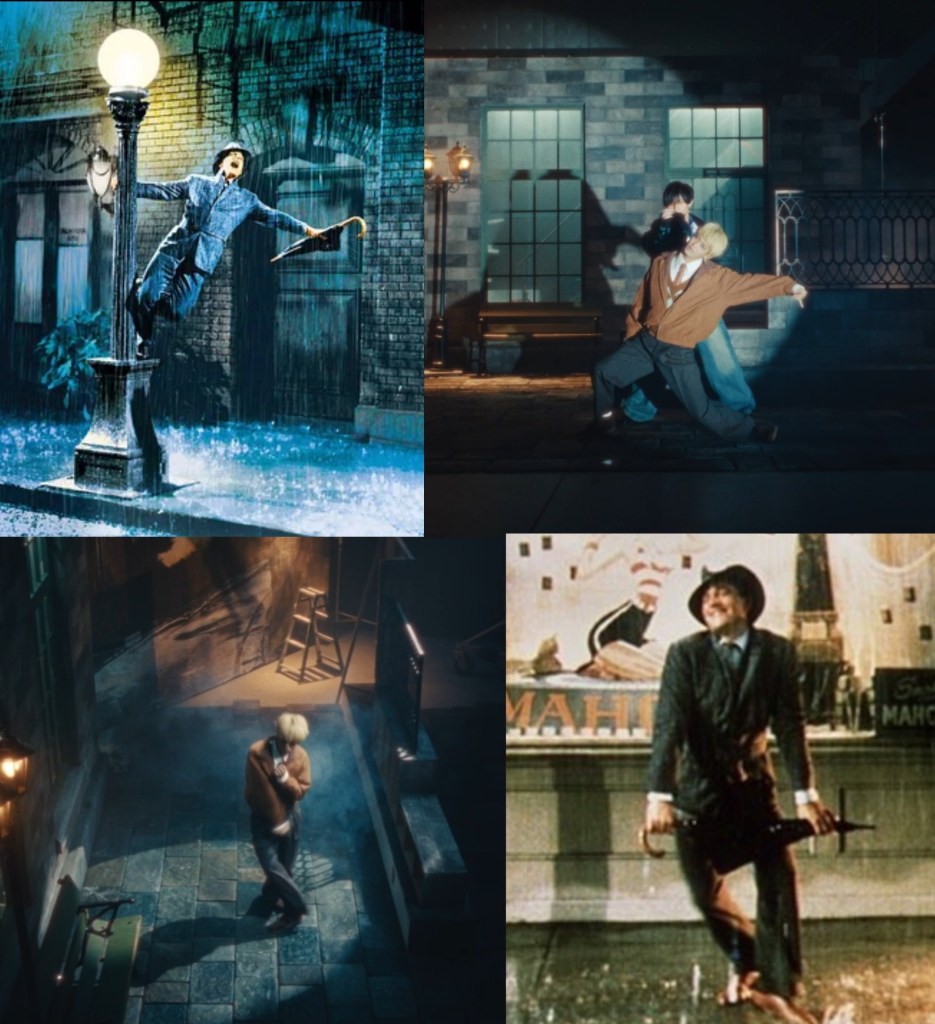
“Singin’ in the Rain”: The aesthetic of the streetlights, the use of classic suits, and the elegance of the dance moves directly refer to Gene Kelly. There is a sense of classic optimism that permeates the dance scenes under warm lights.
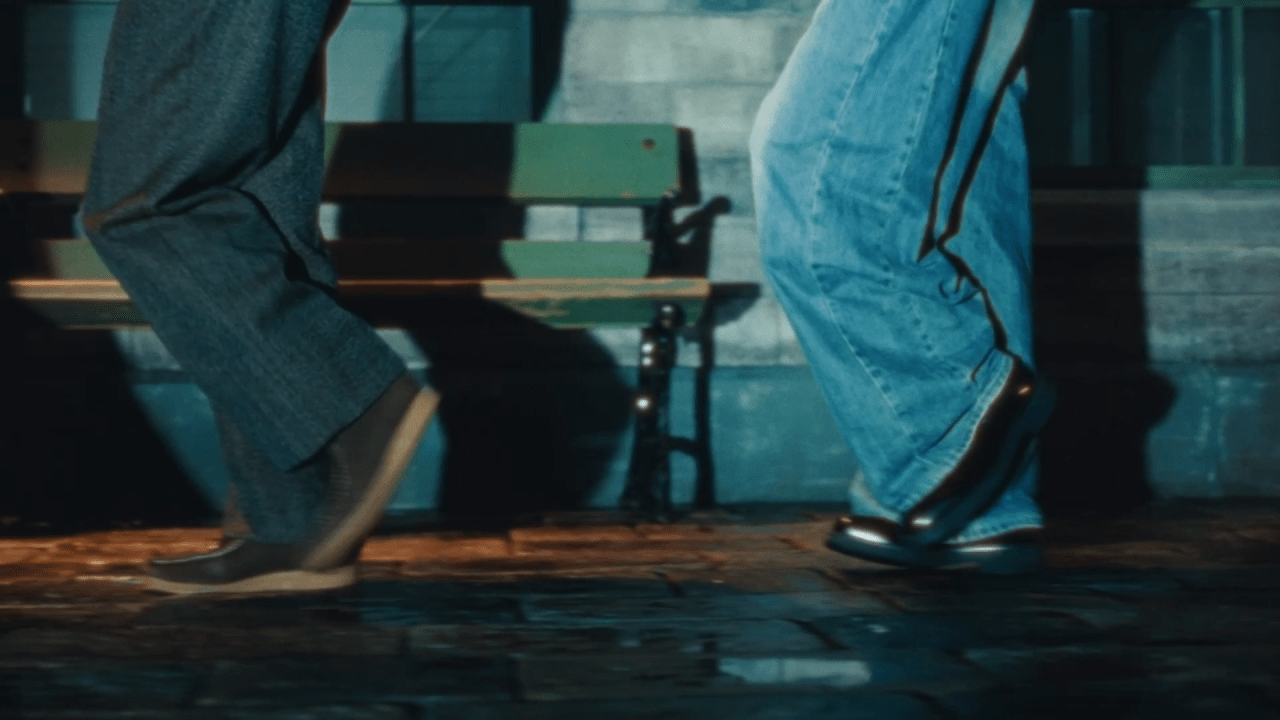
Even if the viewer may think that in this scene it is not raining as it happens in the movie, we just need to look a little closer, because as can be seen in the following frame, under the feet of Kaito and Ren we can see that it has just rained!
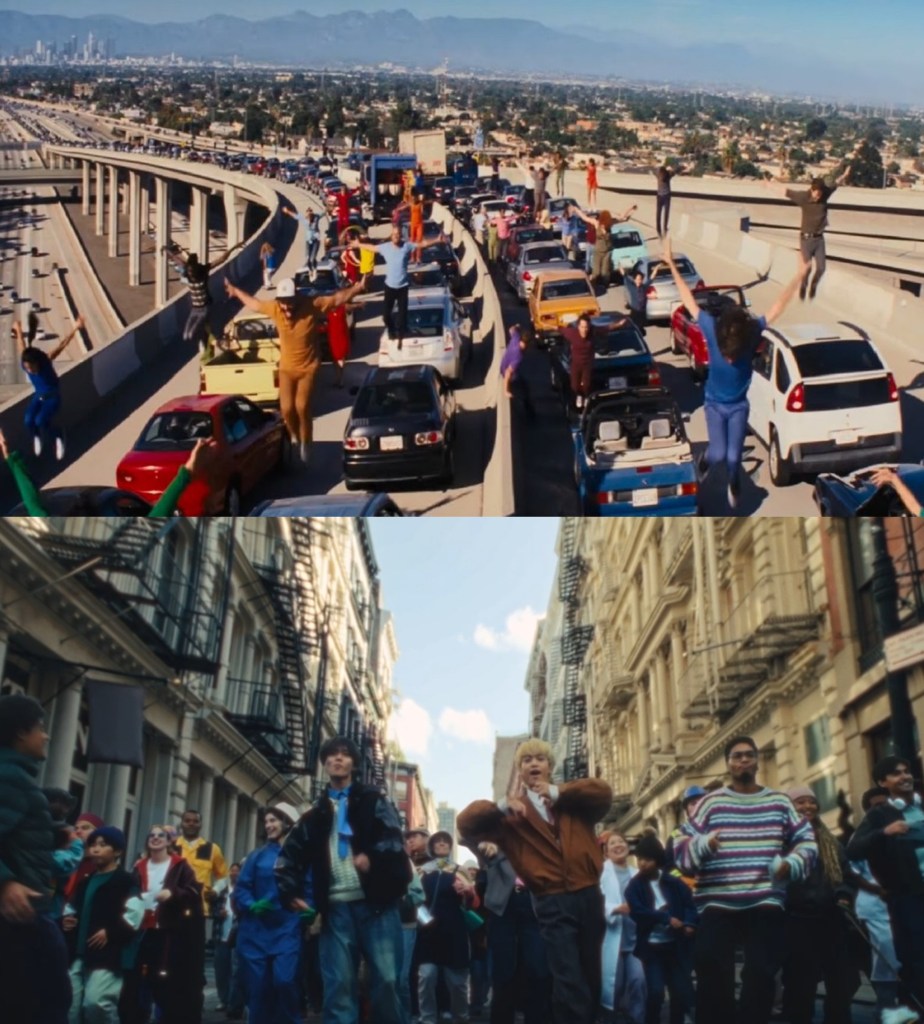
“La La Land”: The use of color and lighting (especially the blue and purple tones in the more reflective moments) is very reminiscent of Damien Chazelle‘s cinematography. The choreography on sets that look like cardboard backdrops plays with the thin line between reality and cinematic scenery.
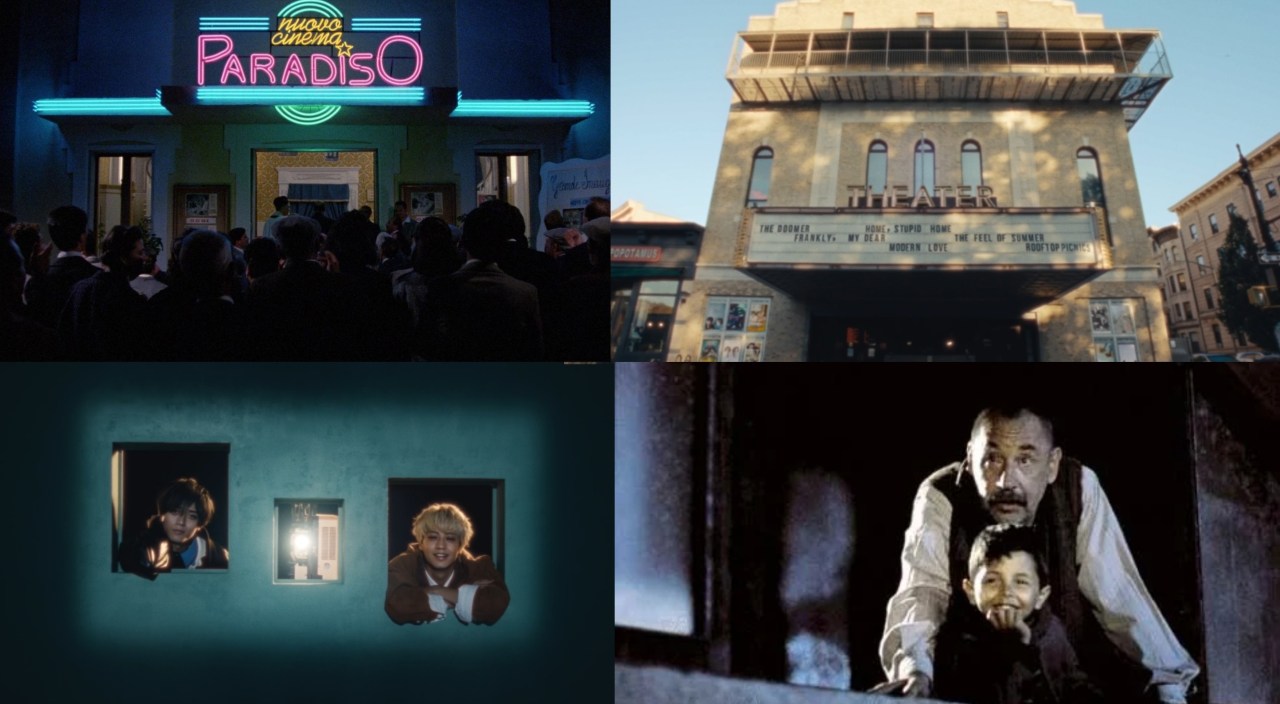
“Cinema Paradiso”: Although it is Italian, its influence on Hollywood is immense. The image of the artists sitting in a dark theater watching old films appeals to the melancholy of cinema as a place of refuge.
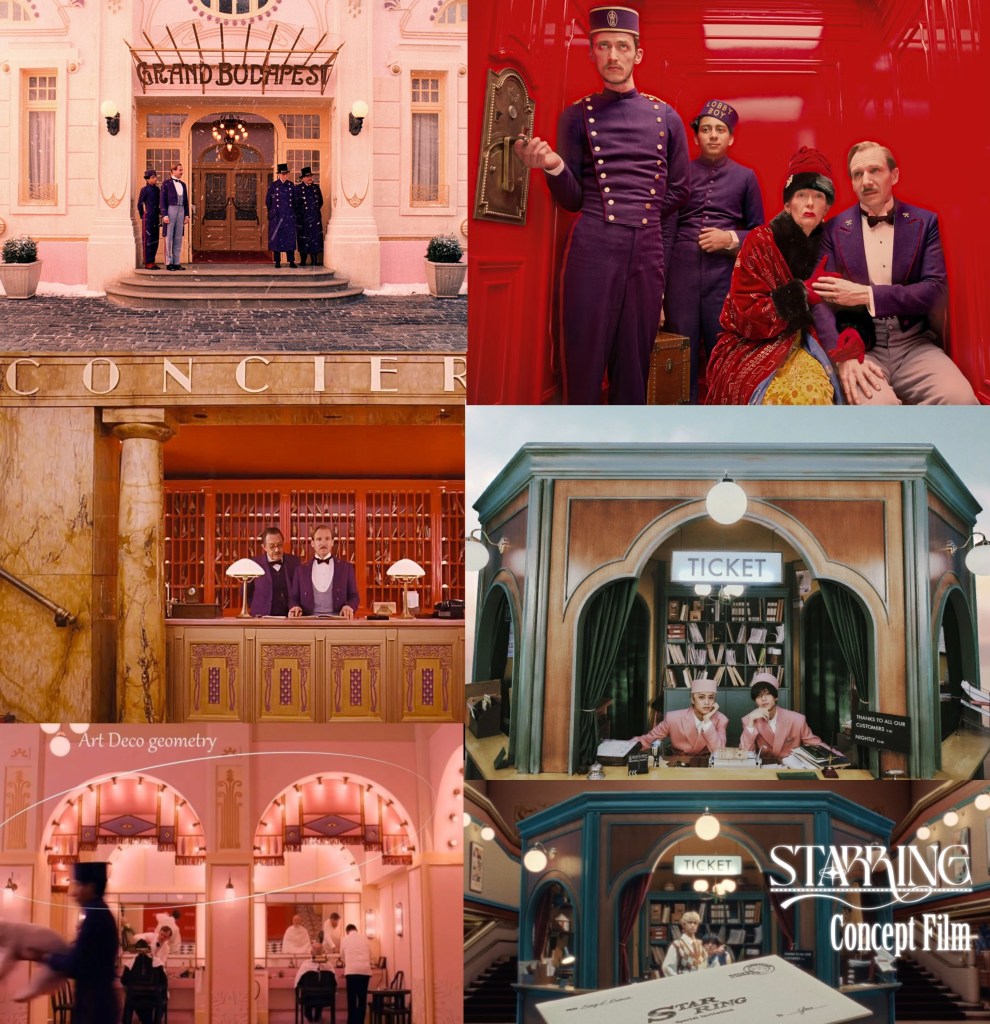
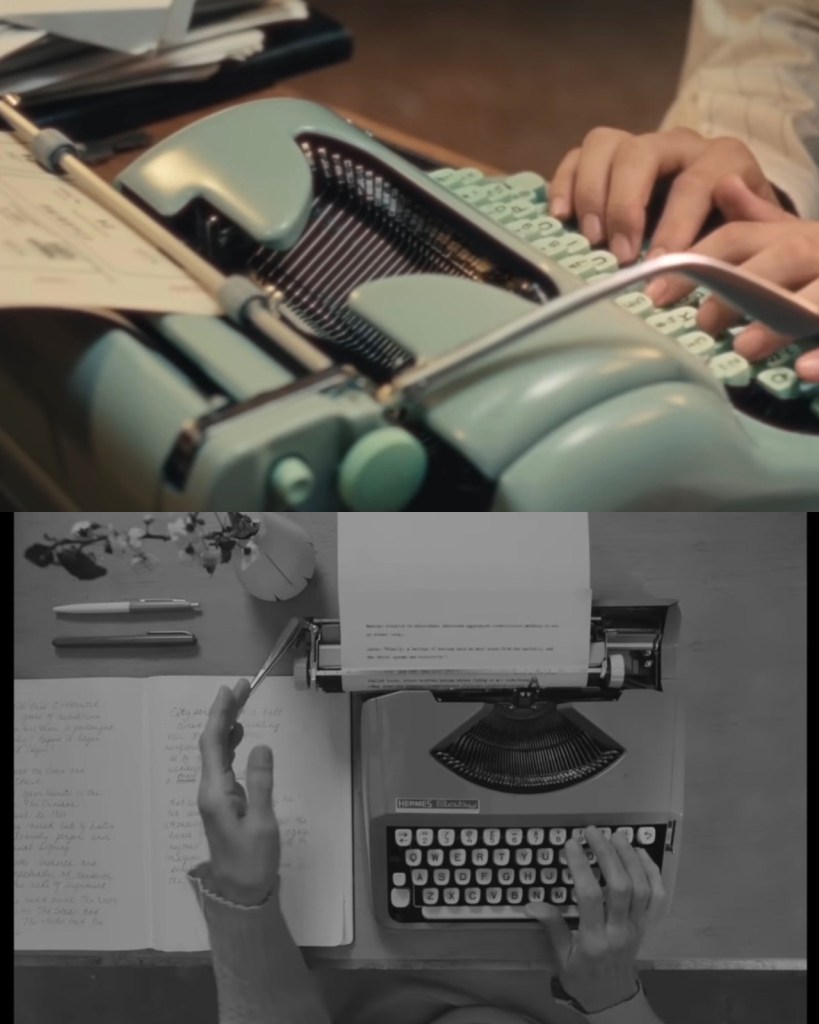
Other references, perhaps not as direct but just as important, can be found in other details such as regarding the use of homages, both the album cover and the opening visuals evoke a distinct Wes Anderson aesthetic, specifically, the pink costuming draws clear inspiration from The Grand Budapest Hotel, while the typewriter sequence serves as a direct nod to The French Dispatch.
The lyrics as an introspective journey through the emotions of “Theater“
To analyze the lyrics of “Theater” and its connection to the idea of escape into fiction, it is fundamental to understand that the song describes not just a physical space (the cinema), but a mental state where art becomes a refuge from reality.
Cinema as an Emotional Refuge: The lyrics establish from the beginning that the ‘theater’ is a place where the worries of the outside world disappear. The recurring phrase “Welcome to our theater’” is not just a welcome to the viewer, but an invitation to enter a safe space where King & Prince act as guides for this sensory experience. Connection with fiction; the clear premise is that life and art meet at this middle ground. The lyrics suggest that, faced with a reality that can sometimes be “aggressive” or “monotonous”, fiction offers a “nostalgic and grand atmosphere” in which one can lose oneself to heal.
The Duality between Reality and Performance: The song constantly plays with the idea that we are all protagonists of our own stories. By stating that “Ren and Kaito act as protagonists of their own fictions,” the lyrics reinforce that identity is something flexible within the world of art. There is a need to “fly away” (escape) mentioned in the lyrical fragments. This desire to flee is satisfied through the interpretation of roles. By adopting the aesthetics of films like “Back to the Future” or “Harry Potter“, the artists (and by extension the listeners) stop being ordinary people to become heroes of an epic narrative.
Nostalgia as an Anchor: Musically, the use of 90s Funk and R&B evoke a “golden era”. The lyrics use this nostalgia not as a desire to go back in time, but as a tool to create “anchors” of security for the viewer. The central message is that art is an “eternal refuge”. While time in reality is linear and sometimes cruel, in King & Prince‘s “Theater,” magical moments can be suspended indefinitely, just as in the reference to the film “Big Fish” that appears in the MV.
“Show Time” as an Act of Resilience: The song’s climax, with the “Show time” section at the end of the MV, functions as a statement of principles: “The show must go on“; This phrase connects the need to escape with the need to keep moving forward. Fiction is not just a passive distraction; it is the fuel that allows the protagonists (and the audience) to face the ‘life’ with a renewed and creative mindset.
In summary, the lyrics of “Theater” propose that fiction is not a lie, but a necessary alternative truth for processing real life!
The Concept of “Movie within a Movie”
King & Prince‘s latest project, “STARRING“ goes beyond a standard album, it’s an immersive experience where every track serves as the OST for an imaginary “film”. Guided by the theme “12 stories told through music“, the album offers a visual catalog where each song embodies a unique genre and storyline, using “Theater” as a common thread.
Adventure/Fantasy Genre: We have tracks like “this time“ (Kaito’s solo), which acts as the OST for Frankly, My Dear, or “4月1日“ (April 1st), which shares its title with the track, where the protagonists live the same day over and over, unable to move forward in time. We also find “Stereo Love“ as the theme for the “film” “Home, Stupid Home“
Action/Sci-Fi Genre: The snippet of “The Doomer“, paired with its OST “I Know“, represents the most dynamic and rhythmic side of the album. Here, the music serves as the backdrop for a narrative centered on unconventional heroes.
Musical/Romance Genre: In this category, we find “Modern Love” as the backdrop for the song “HEART,” while Ren’s solo, “Darling,” provides the melody for the film “Haruka 記憶の中のあなたへ” (Haruka: To You in My Memories).
The song “Theater“ is, by definition, the title track that unites the entire project. While the other songs on “STARRING” album are individual soundtracks, “Theater“ is the piece that gives meaning to the whole; it explains that life is a movie and King & Prince are the directors choosing which story to tell at any given moment.
This interplay between visuals and melody is more than just aesthetics; it is a way of telling the listener that by playing the full album, they are entering a “film marathon.” Each song allows the listener to “escape” into a different fiction, using music as the necessary bridge to process reality through fantasy.
The MV is, therefore, the visual catalog of “STARRING“. The fragments we see are the “trailers” for the films that the audience can “watch” (listen to) through the album’s tracks.
Viral “Shoulder Dance”: The Cinematic Spark of “Theater” on Social Media
Another part of this release to highlight is the opening fragment of the MV, where Kaito walks while moving his shoulders. It has become the most viral moment of the video, generating a massive impact on platforms like TikTok, X or Intagram, causing the short version of the MV to reach millions of views on YouTube even before the full song had been released.
This sequence has resonated deeply due to the viral impact of Kaito‘s “shoulder dance,” whose relaxed style has inspired countless social media videos. His charisma and presence while walking toward the camera evoke the elegance of Hollywood’s Golden Age protagonists, projecting a confidence that captivates the viewer. Furthermore, the perfect synchronization of his steps with the song’s groove has turned the clip into highly shared content, highlighting his skill as a lead dancer, while the impeccable visual aesthetics of the video’s opening create a nostalgia effect that attracts a global audience beyond the usual fandom.
This brief fragment has not only served as the best introduction for the single but has also consolidated Kaito as a visual and choreographic reference within the current J-Pop landscape.
For all this, we can affirm without fear of being wrong that “Theater” is more than just a music video; it is an exercise in metacinema, a triumph of audiovisual production that elevates King & Prince‘s status from singers to storytellers. By integrating such powerful references as Ghostbusters or Back to the Future, the group not only appeals to its fan base in Japan but also creates a universal language understandable to any lover of world cinema. Kaito and Ren succeed in encapsulating the magic of Hollywood while maintaining their identity as modern idols. The MV reminds us that, just like in a movie, the show must go on, and they are ready to remain the protagonists of this new era.
Follow King & Prince for more updates!
STARRING special accounts!
Kaito Takahashi Instagram account
Ren Nagase Instagram account | Ren Nagase FC
MORE KING & PRINCE ON DUMPLING BOX!




Something went wrong. Please refresh the page and/or try again.