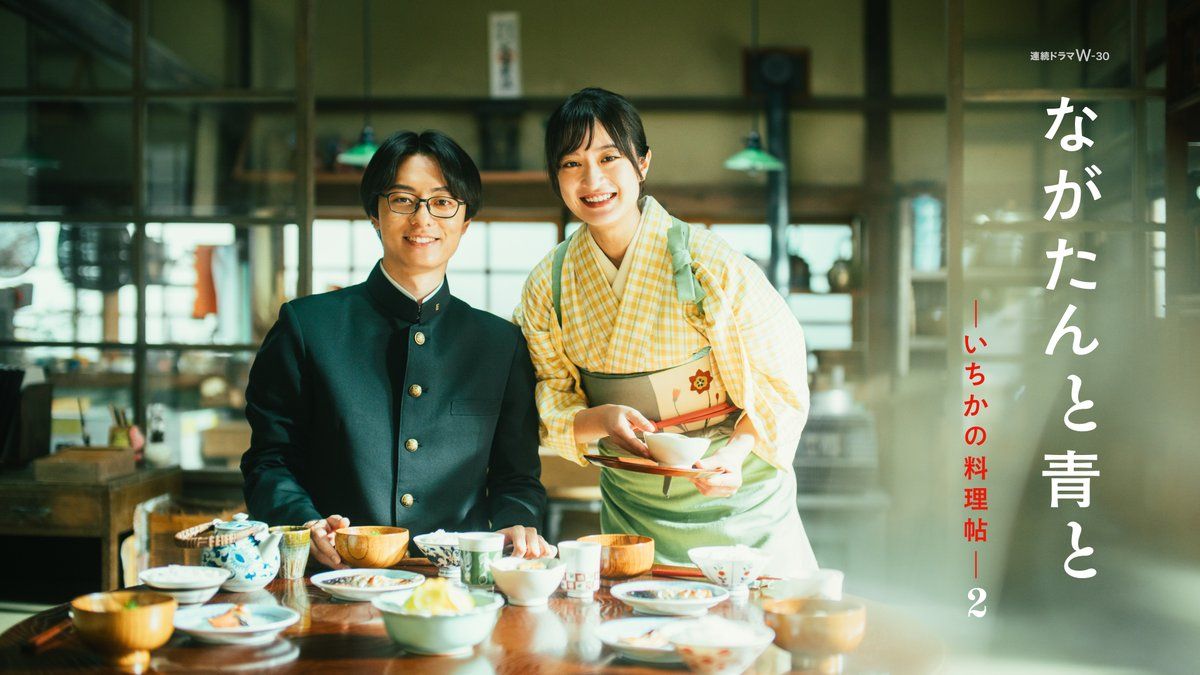
The drama “Nagatan to Aoto: Ichika no Ryori Cho” starring actress Mugi Kadowaki and ACEes member Ryuto Sakuma is currently airing its second installment from February 20, 2026 as part of WOWOW’s “Drama W-30” lineup. Based on the manga of the same name by Yuki Isoya, this gourmet love story set in Kyoto shortly after World War II is returning for the first time in three years.
The new season depicts events one year after the 15-year age-gap couple’s marriage. With the addition of a new family member and the appearance of the second son of the Yamaguchi family, new trials befall the traditional restaurant “Kuwanoki,” which had only just begun to recover. A series of environmental changes press upon the couple, greatly shaking their relationship.
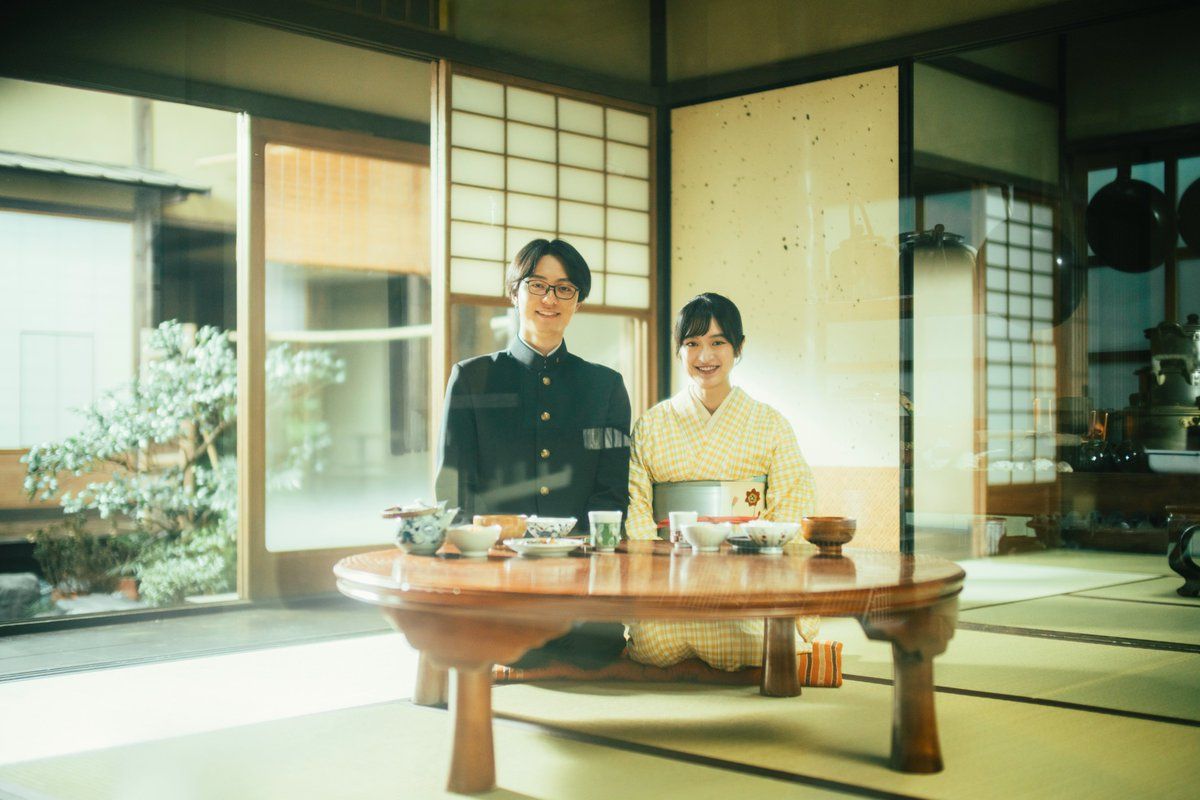


The production team returns from the previous season. The main director is Soushi Matsumoto, who has worked in projects such as the 2024 drama “Chastity High” and the 2021 films “It’s a Summer Film!” and “The Aobas’ Dining Table,” joined by Ayumi Ichioka, who has also demonstrated her skills in Toei Kyoto productions. The script is once again written by Izumi Kawasaki, who is known for “I Hear the Sunspot” (2024) and the “A Man Who Defies the World of BL” series, continuing to support the richly crafted world of “Nagatan to Aoto.”
Kadowaki, an accomplished actress active in both theater and film, reprises her role as Ichika Kuwanoki, a heroine who confronts hardships through creative cuisine blending Western and Japanese elements. Sakuma, having gained experience through various dramas and starring film roles such as “My Love Story with Yamada-kun at Lvl999” (2025), returns in a matured form to play Amane Yamaguchi, Ichika‘s husband, who takes on the management of “Kuwanoki.”
In an interview with Eiga Channel, Sakuma spoke at length about returning to Kyoto for filming, his feelings about the project, and where he stands now as an actor.
Q: The second season of “Nagatan to Aoto: Ichika no Ryori Cho,” which was well received when it aired in 2023, is now broadcasting. Not only drama fans, but you yourself must have been looking forward to this day. How did it feel returning to film Nagatan to Aoto after some time?
Sakuma: “It’s my first time back at the Kyoto studio since the previous Nagatan to Aoto. On the Shinkansen ride there, around Nagoya, it suddenly hit me — ‘It’s finally starting.’ I was also really happy to reunite with the staff. One of the veteran costume staff members is about the same age as my grandmother. She told me she had been considering retiring, but when she heard about Season 2, she was so happy she decided to participate. Hearing that made me even more excited for filming.”
Q: It must have been your first reunion in three years. What did the staff say to you?
Sakuma: “I’d hear things like, ‘You haven’t changed — you’re still young!’ and then also, ‘You’ve become more mature’ (laughs). They looked at me like I was their son or grandson and really doted on me again this time.”
Q: What kind of direction did director Matsumoto give you? Was there any change from the previous season?
Sakuma: “Even after the first season ended, I kept in touch with Director Matsumoto. But once we actually started filming, there was surprisingly no big discussion about the new season (laughs). I told him, ‘If there’s anything about Amane’s acting that concerns you, please let me know,’ but he only gave small instructions here and there on set. There wasn’t any big-picture explanation. I actually think that might have been his way of saying, ‘You’re fine just as you were in the first season.'”
Q: Since the story continues from the first season, that makes sense. Was there anything you were particularly mindful of in your performance this time?
Sakuma: “For Episodes 1 and 2 of Season 2, I tried not to change anything drastically from before. But from Episode 3 onward, new characters come into the story, so I thought carefully about how Amane would react to them.”
Q: New characters play key roles in this season: Michiya Okabe (Kota Mano), a boy who becomes part of Ichika and Amane’s family, and Sakae Kawashima (Toranosuke Kobayashi), who stirs things up at Kuwanoki. First, tell us about acting alongside Mano as Michiya.
Sakuma: “I was really curious how Ichika and Amane would change once Michiya joined the family. Mano-kun is extremely serious, and you can tell from his acting how much preparation he does. That made both Kadowaki-san and me feel at ease. Before we knew it, we were playing games and taking photos together — we naturally grew closer. On set, he felt like a little brother.”
Q: Through Michiya, we start to see Amane’s fatherly side.
Sakuma: “I’ve often been told I look older than my age, so my ‘old-man vibe’ actually worked well here (laughs). Usually I want people to think I look young, but for this project, I was glad I seemed more mature than my actual age.”
Q: Kobayashi, who plays Sakae, is around your age. You had many scenes together — how was that?
Sakuma: “Our first scene together involved playing chess. We were both shy, and it was… honestly like time in hell (laughs). But now we can laugh about it and say, ‘That was really tough, wasn’t it?’ Toranosuke had to act in dialect and had a lot to handle from the first day, plus it was our first time working together and the scene was intense. It must have been challenging.”
Q: Did things become more natural afterward?
Sakuma: “That’s thanks to Kadowaki-san. She kept the conversation flowing so we could relax. Without her, two shy guys like Toranosuke and me might not have managed (laughs).”
Q: She sounds like a very reliable heroine. How was it acting with her again?
Sakuma: “Since the first season, Ichika has spoken in Kyoto dialect. Meanwhile, Amane speaks standard Japanese, so I always thought it must be hard for her to juggle both dialect and performance. But this time, I also had quite a few Kansai dialect lines, and I was panicking like, ‘What do I do?!’ Unlike me, she never once showed any sign of struggle. She must put in a lot of effort, but on set she’s completely composed and never lets it show. That’s really cool — I truly admire that about her.”
Q: When Season 2 was announced, you commented, “I get to go back to Kyoto. It feels like summer vacation in my life.” Did you create any fun memories outside of filming?
Sakuma: “Filming coincided with the release of “Demon Slayer: Kimetsu no Yaiba – Infinity Castle Arc: Chapter One – Akaza Returns” (2025). In Tokyo, even after filming, I often have other work and can’t easily make time for the movies. But in Kyoto, after shooting, I went to a late-night screening. It wasn’t too crowded and was really comfortable. On a day off, I also went to Amanohashidate. The manager and ACEes member Ryusei Fukada are from Tokyo, and the three of us went sightseeing together. I really enjoyed it.”
Q: Kyoto studios have a lot of history. Did anything happen that felt unique to filming there?
Sakuma: “Multiple productions happen simultaneously, so in the costume rooms and makeup rooms, actors and staff from different projects are constantly coming and going. One time I was changing in the costume room and a legendary veteran actor was suddenly behind me… my heart nearly stopped. I quickly slipped out. There’s that kind of tension. But there were also renovated areas, so I went to check them out. Even though they’re newly updated, they make them look unchanged from the previous season on screen. The art team’s skill is incredible.”
Q: You’ve steadily built your career as an actor. Do you find acting enjoyable? What draws you to it?
Sakuma: “Acting is fun. When a scene is joyful, it’s genuinely joyful. When it’s sad, I truly feel sad. When it’s unpleasant, my mood becomes heavy. It’s such a profound job — your own emotions merge with the character’s. Through acting, I can challenge things I could never do alone, go to time periods I’d never experience in real life, try different professions. Within the framework of acting, there are so many detailed genres — that’s what fascinates me.”
Q: What sparked that sense of enjoyment for you?
Sakuma: “The film “Hiraite” (2021) was my first movie appearance. As an idol still in a junior position before my debut, it was unusual to be in such a serious story. It was a very unique project. While staying in a regional area during filming, watching so many adults come together to create one work made me realize, ‘I’m part of something incredible.'”
Q: Director Rin Shuto once mentioned that you stayed on set to observe even after your scenes were finished.
Sakuma: “I love gadgets, so I’m interested in filming and lighting equipment. Also, since I was alone at the hotel, I thought it was better to stay and absorb the atmosphere on set. It was also a learning experience. Even during the first Nagatan to Aoto season, I’d stay and observe when I wasn’t needed in scenes. I spent a lot of time with the staff and cast. Maybe I just really love the atmosphere of a filming set.”
Q: The show is often called a ‘food-terror’ drama because the dishes look so delicious. Meals bring people together and create connection. Do you feel the importance of eating with others?
Sakuma: “Recently, the ACEes members have been going out for meals more often. The other day after work, we held a ‘Let’s Have Some Tea’ gathering (laughs). We just sat in a café and talked. I think that kind of time is important. Whenever relationships deepen, food is usually involved — like catering at live venues or yakiniku together. When you share good food, it feels like the distance between you shrinks. So I want to cherish mealtimes.”
Q: Which dish in the drama was the most delicious?
Sakuma: “The rolled omelet Ichika made. I cook it occasionally too, but making it thick and fluffy is hard. The flavor of the dashi really made it — it was delicious.”
Q: Lastly, what do you think is the charm of this drama and of Amane?
Sakuma: “Our producer calls Nagatan to Aoto ‘WOWOW’s morning drama,’ and it really has that kind of warmth. It starts as a political marriage story, but the tone is soft and easy to watch for all ages. Amane can be clumsy, but he thinks for himself and sincerely tries to protect his family and Kuwanoki in his own way. That’s what makes him such a good guy.”
Q: Is there a scene you especially love?
Sakuma: “I like the end credits. Each one is shot in one long take, full of ad-lib lines not in the script. There’s no audio used, so even Kadokawa-san speaks standard Japanese there (laughs). Watching myself, including how I stand and move, I was surprised at how much it was just ‘the real me.’ I almost wish I’d thought more carefully about what I said and did (laughs). Season two introduces new characters and expands the story. It’s packed with interesting details, so I hope everyone enjoys it.”



![[GIVEAWAY!] ACEes Arena Tour 2026 “V” Goods](https://dumplingbox.org/wp-content/uploads/2026/08/acees-v-giveaway-1200x900.png?crop=1)