
When the curtain fell on ANDO, there was no grand spectacle left—only quiet gratitude, shared glances, and the kind of silence that comes after you’ve given everything you have. What lingered on stage wasn’t just applause, but the pulse of something lived and felt—fifty performances’ worth of dreams, doubt, laughter, and courage.
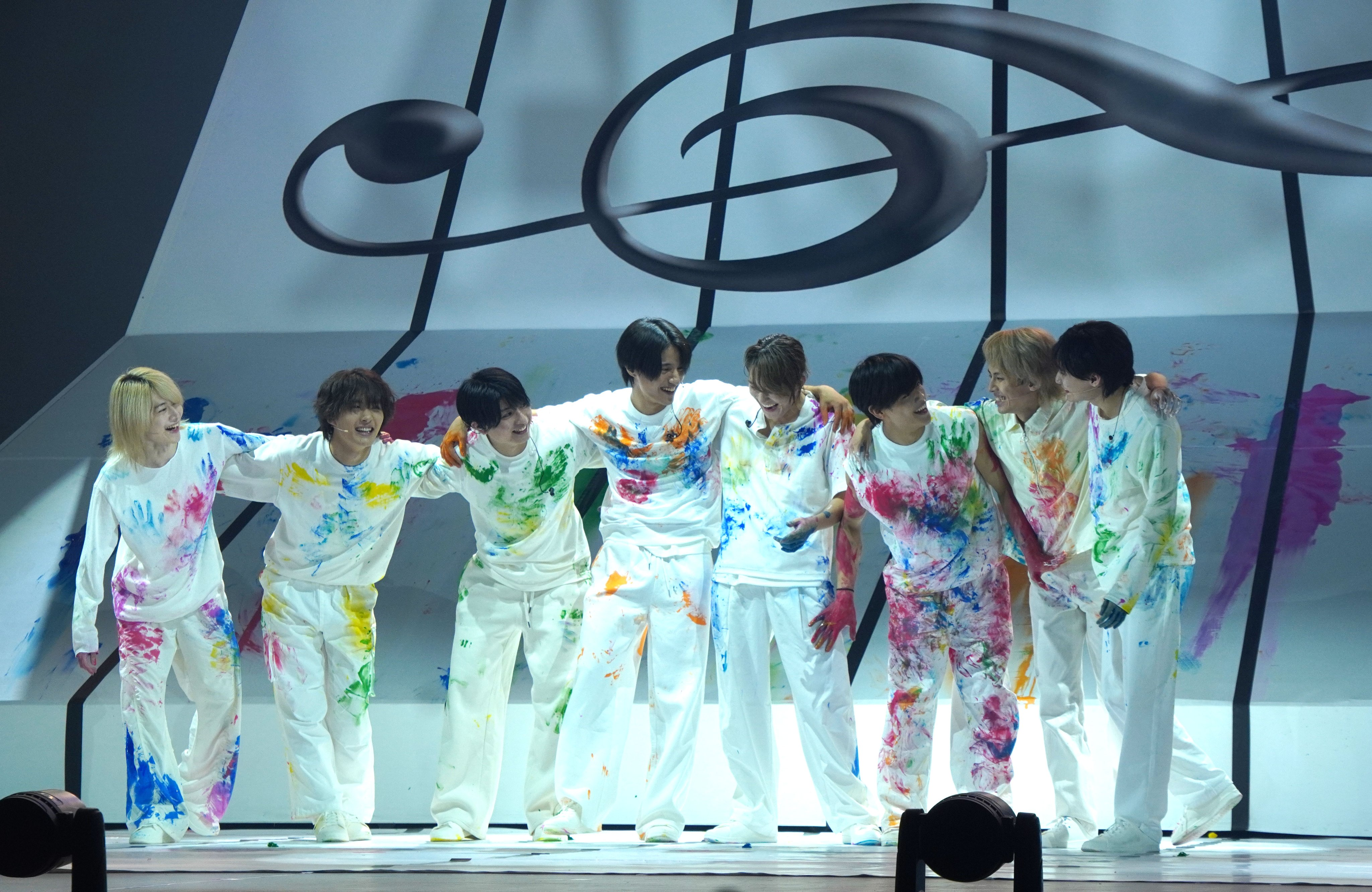
Produced under Shochiku and performed at Shinbashi Enbujō, Hiroshima Bunka Gakuen HBG Hall, and Osaka Shochikuza, ANDO marked B&ZAI’s first-ever headlining stage play—an ambitious fusion of live band performance, acting, dance, and storytelling.
The play follows eight university friends—Ando (Hoshiki Kawasaki), Mocchi (Rei Yabana), Sato (Rinne Sugeta), Yonemoto (Katsuki Motodaka), Shion (Ryo Hashimoto), Nagumo (Michiharu Inaba), Skull (Taiki Konno), and Tsukito (Yujin Suzuki)—who reunite years after graduation to form a band once more. As they confront their pasts and futures, the story becomes a meditation on friendship, loss, and the meaning of home.
At the press event ahead of opening day, the cast expressed their excitement and determination.
“As B&ZAI, this is our first time leading a stage together,” said Ryo. “We want to deliver a performance that blends band and dance in a way only we can.”
Rinne described the production as “a show where the sound of a live band fills the Enbujō—something truly special,” while Michiharu reflected on the challenge, saying, “It’s a stage packed with things only B&ZAI can do. I hope the audience enjoys every moment.”
“This play is something that could only be made by us. I hope everyone joins us with warmth and excitement,” Taiki added.
From Yujin’s cheerful, “There’s band, dance, laughter, and tears—please enjoy it all,” to Rei’s promise of “a new kind of stage experience,” their words carried both anticipation and affection for what was to come.
But ANDO would ultimately grow into something deeper. For B&ZAI, it became a mirror reflecting where they’d come from and a compass pointing toward where they’re headed. In February 2025, when STARTO ENTERTAINMENT’s Junior groups underwent a major reshuffle, both fans and members alike faced deep uncertainty—unsure of what the future might hold for their beloved teams.
For B&ZAI, ANDO became the answer: a declaration that they could rebuild, unite, and move forward stronger than before. Born from uncertainty, the group’s formation itself carried the weight of countless questions—Can we do this? Can we keep going?—and yet, performance by performance, they proved that hope could be rebuilt, piece by piece, together.
Each member’s final words at curtain call revealed what ANDO had truly meant—not just as a stage, but as a shared turning point in their lives. It was livestreamed for free on FAMILY CLUB Online for Junior FC members, allowing fans to share the moment together from the comfort of their own homes, with an archive later uploaded for FC viewing. The speeches that followed—captured in those final minutes—were roughly what they spoke about, filled with raw honesty and emotion that transcended the screen.
“We exist because of you—and because we exist, we were able to meet all of you. I really feel that deeply, and it overlaps with the meaning of ANDO itself,” Michiharu spoke softly. As the youngest, his gratitude carried the core of the production’s message: connection. For fans who have followed their journey from uncertainty to unity, his words felt like both a thank-you and a promise—that their existence as idols is intertwined with the people who believe in them.
Hoshiki echoed that sentiment through one of the play’s central lines: “Because you’re here, I’m here.” It’s a simple phrase, yet profound in how it captures the relationship between artist and audience. As he reflected, “Because you—the fans—come to see us, we can continue to exist as idols.” Those words became an emotional refrain throughout ANDO, one that reminded everyone present that the group’s heartbeat is shared.
“To sum up ANDO in one word—it was fun. The simplest word, but also the best one, right? I mean, come on, getting to play guitar and sing for fifty performances—that’s the best thing ever!” Yujin said with a grin that carried both relief and pride. “There’s nothing happier than that. Being able to share this space with everyone who came to see us, I feel incredibly blessed. Thank you so much. I’ll keep doing my best from here, too.”
Rei connected ANDO’s narrative to his own life with moving sincerity. “Every character in ANDO moves forward by their own decision, by their own will, and I think that’s how the story ends—on a hopeful note,” he said, his voice steady yet filled with emotion. For him, hope was inseparable from choice. He reflected on how each of the eight members’ paths converged here—“The two who decided to leave us, the three old friends who chose to stay and continue playing in the band with me, and the four new members who joined this ship with incredible determination—each and every one of us stands on this stage by our own choice.”
He spoke honestly of how difficult the past year had been—how uncertainty shadowed their steps, and yet, standing under the lights now, he could finally say with conviction, “Half a year ago, I could never have imagined seeing this view. I’m just glad I chose this path.” He described the fifty shows as a shared evolution, where countless ad-libbed moments and spontaneous scenes tested their instincts and deepened their connection. “Overcoming those moments made us stronger,” he said, “and I believe B&ZAI will only continue to grow—next year, five years from now, ten years from now.”
Rei’s gratitude extended to everyone who helped make ANDO possible—the agency who believed in them, the staff and Juniors who supported them, and the fans whose presence made every performance alive. “It’s thanks to the agency that the eight of us can stand on this stage today,” he said. “It’s thanks to the decisions each of us made that this stage exists at all. And most of all, it’s thanks to everyone here in this venue, and everyone watching and supporting us. I know there were moments that made you think too much, or feel conflicted—but it’s because of you that we’re able to stand here. Please continue to support us.”
His reflection captured what ANDO means to both cast and fans—a story about standing back up, facing what’s ahead, and continuing forward, no matter how uncertain the road. His words carried the clarity of someone who had rediscovered his own purpose through this artistry, proving that in choosing to stay, they had already taken their first step toward tomorrow.
Rinne, ever introspective, shared how the repetition of fifty performances transformed the play into something deeply personal. “Once the opening or the ending songs finish, I start feeling this loneliness—like, maybe I won’t get to see this view again, or I won’t get to say this line anymore.” Each performance, he said, made every word and moment heavier with meaning.
He reflected on one line that struck him the most—“What is it that I really want to do?”—and how it mirrored his own struggle after two members decided to leave the group last year.
“I was really frustrated. I didn’t know what to do or where I was heading,” he admitted. He spoke openly about those months of uncertainty—how he sought advice from seniors, agency staff, and family, trying to find direction.
Eventually, he found it: “The agency created a place for me. They gathered members who love making music, and I was able to find what feels like a home—a place where I could look forward again and truly feel happy.” His words carried the quiet relief of someone who had fought through doubt and rediscovered purpose.
For Rinne, ANDO became not just a stage, but a declaration of intent. “We decided to do this ourselves. We have no regrets. We’re happy now. There’s no more hesitation. We want to move forward as this group and grab hold of our debut with our own hands—faster than anyone else.”
For fans who have followed him since the beginning, his honesty was striking. It was more than a curtain call—it was the sound of conviction returning. His reflection encapsulated what ANDO symbolized for B&ZAI: the moment uncertainty turned into direction, and hardship into home.
Taiki, who was voted as leader earlier during their first tour, First Beat, stepping into the role with humility and warmth, and who has since carried the group through hardship, spoke with a mix of strength and emotion that filled the hall.
“The only reason we were able to make it through all 50 shows was because of all of you who came to see us, the members, the staff, and all our juniors who performed alongside us. I have nothing but gratitude—thank you so much.”
He paused, visibly moved, as he spoke about watching over the group since their rebirth. “After we reunited as B&ZAI, we got to perform First Beat, and from there, I was given the position of leader. Since then, I’ve been watching everyone—not from above, but from behind, keeping an eye on each one. And honestly, they’re all such good guys. I’m really lucky to be their leader.”
He reflected on the difficult road that brought them here. “We’ve all been through tough times, but thanks to the agency giving us what might’ve been our last chance, we were able to continue as this group—B&ZAI.” His voice broke slightly as he continued, “As leader, there’s something I really want to accomplish—for this team, for B&ZAI, for our fans: our BaetZ. I will make you happy. All of you.”
With tears barely held back, he pressed on, his words echoing through the venue: “Like Rinne, I’m not good with words, so I don’t know if I’m expressing this well—but I hate lying more than anything. So let me say this head-on: we’re going to debut, faster than any other group. We’re going for it at full speed. So I want you to come with us.” Then, after a pause, he added softly but firmly, “No—actually, not just follow us. Take our hands, and let’s lift this group up together.”
The audience erupted in warmth, their response immediate and heartfelt. For every fan who had waited, worried, and believed, his words were more than a promise—they were a vow. In that moment, the boundaries between stage and audience dissolved, and what remained was a shared conviction: that no matter how steep the climb, they would face it hand in hand.
For Taiki, it wasn’t just a leader’s speech. It was an open-hearted declaration of love—for his members, for their supporters, and for the future he could finally see taking shape before him.
Katsuki reflected on the meaning of the story itself, his words calm but laced with emotion. “During these fifty performances, I found myself constantly thinking—what exactly is ANDO? What does it represent?” He explained how, as the performances went on, he began to see how deeply their own lives and struggles were woven into the story. “Deep within this story, the lives of us—B&ZAI—run strongly through it. This stage made me realize how precious it is to have a home, a place where we belong.”
He spoke about the weight of the group’s history—how, after two members chose to leave, the remaining members spent months unable to see what lay ahead. “For a long time, we couldn’t see forward. I tend to blame myself if I can’t give one hundred percent, and I fall into frustration easily,” he admitted. “But these members understood me and encouraged me through it all.”
He went on to describe how the new lineup, though not born of long friendships, was held together by something even stronger: music. “HiHi Jets, 7 MEN Samurai, Shonen Ninja—we were all brought together from different roots. But that isn’t a weakness; it’s our strength. By mixing our individual experiences, B&ZAI was born. Through creating this work together, I felt that more deeply than ever.”
The group’s new original song, “Ain’t No Dream Over,” was also something he spoke about, and how its message of enduring dreams mirrored their own. “The dream we once lost sight of—this group, B&ZAI, gave us the strength to make sure it wouldn’t end. That’s what I poured into every performance of that song.”
Katsuki’s voice softened as he looked toward the future. “A group is like a family. I hope our juniors, who joined us on this stage, will one day find their own groups and stay with their companions forever. If this production becomes a spark for that, then it truly meant something.” His words connected the dots between the fiction of ANDO and the real growth of the group itself—reminding everyone that even through change and uncertainty, what endures is the will to keep creating together.
Finally, Ryo—whose calm warmth often grounds the group—brought everything full circle. He reminisced about the earliest days before B&ZAI even had a name. “When there were just four of us, I wondered if there was some way we could make something of it… and with the agency’s support, we met each other. Honestly, it’s scary to think what might’ve happened if we hadn’t.”
He smiled at the memory of those first uncertain days, recalling how the four of them started out unsure of what their future could be. Yet, even then, he said, they clung to the belief that as long as they stayed together, they could build something meaningful. “We didn’t know if it would work out, but somehow, we just kept going. No one ran away.”
Ryo’s speech was gentle but filled with sincerity. He reflected on how each challenge—every reshuffle, every new beginning—had taught them to rely on one another more deeply. “We’re not perfect, but that’s exactly why we need each other. The people who stayed, the people who joined, everyone who supports us… that’s what makes us B&ZAI.”
For him, the message was simple yet powerful: stay, connect, and keep moving forward—together. His calm conviction tied the evening together, reminding everyone that behind the spectacle and sound, the true heart of B&ZAI lies in the quiet strength of its bond.
Throughout ANDO, the production served as tangible proof that B&ZAI’s hard work since formation is paying off—showing their growing strength, unity, and artistic maturity through live musicianship and teamwork.
The one line that became its living heartbeat: “Because you’re here, I’m here.” On stage and off, those words resonated across every song, every tear, every final bow. It was more than dialogue—it was the truth of who they are.
Their gratitude wasn’t polished or rehearsed. It was awkward, teary, sometimes interrupted by laughter or teasing. But that’s what made it genuine. Each voice carried its own truth—of frustration, perseverance, rediscovery, and hope. Together, they wove a portrait of a group that has already learned what it means to fall and rise again.
In ANDO, they found not only a story to perform but a story that mirrors their own: a narrative about losing one’s place and finding it again through connection. It’s fitting, then, that they call B&ZAI their home—a word that once meant triumph, now reclaimed as belonging.
And so, when they stood together one last time, laughing through tears and promising to move forward, it didn’t feel like a farewell. It felt like the beginning of something new—something rooted in every “thank you,” every missed note, every late-night reflection. Something that, like their name, reaches upward.
The journey from the group reshuffle to this stage has not been easy, but ANDO stands as proof of how far they’ve come and how much stronger they’ve become together. Because even after fifty shows, their story isn’t over.
It’s only just begun.

More B&ZAI on Dumpling Box!
![[GIVEAWAY!] B&ZAI LIVE 2026 Summer Beat Goods](https://dumplingbox.org/wp-content/uploads/2026/08/BZAI-giveaway-1200x900.png?crop=1)




Something went wrong. Please refresh the page and/or try again.