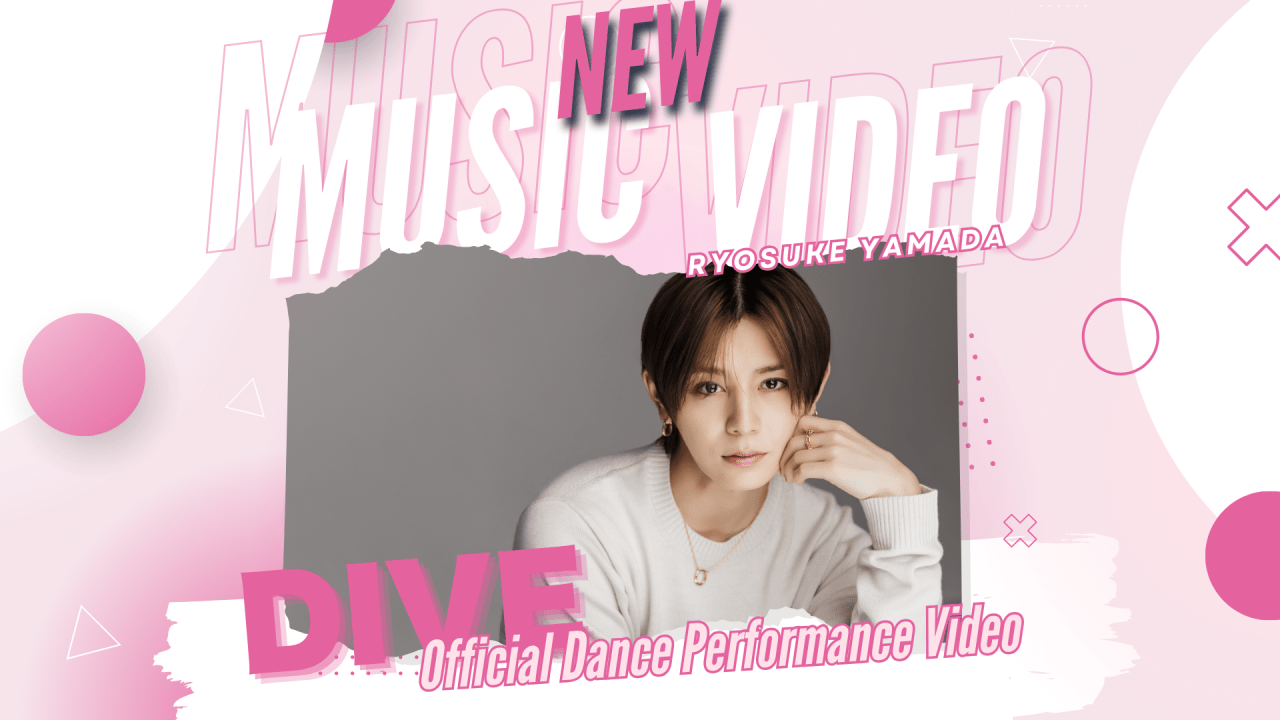
Ryosuke Yamada’s “Blue Noise” surges forward like a pulse you feel before you fully recognize it—a collision of sound, movement, and intent that announces a new chapter not only for Blue Miburo, but for Ryosuke himself.
The music video opens in a world suspended between eras. Steel blues and shadowed blacks dominate the frame, evoking the chill of night streets and unsheathed blades, while flashes of traditional textures—wood, paper, restrained light—anchor the visuals in a distinctly Japanese sensibility. It’s not historical reenactment, nor is it futuristic abstraction. Instead, the MV exists in a liminal space, mirroring the Miburo themselves: men standing between ideals and violence, youth and duty, life before and life after.
Ryosuke’s presence at the center of the video is deliberate and unflinching. He doesn’t perform at the camera so much as through it, his gaze steady, almost confrontational, as if daring the viewer to look away. There’s a physicality to his movement that echoes the song’s restless drive—sharp turns, grounded stances, moments of stillness that feel coiled rather than calm. This is not elegance for its own sake; it’s control born from tension.
Musically, “Blue Noise” thrives on contrast, and the MV visualizes that friction beautifully. Rock and hip-hop rhythms push forward with breathless urgency, while the Japanese elements—both sonic and visual—act like memory, history pressing in from all sides. The edits snap and release, creating a sense of acceleration that never quite resolves. It feels like running toward something you believe in, even when you know the cost.
What makes the MV resonate most, though, is its emotional restraint. There are no overt smiles, no cathartic release. Instead, the video leans into resolve—the quiet, heavy kind. The kind that comes after a decision has already been made.
Visually, blue dominates, but it is never flat; it carries depth, shadow, and memory. Somewhere within that blue, traces of red remain—proof that past chapters haven’t been erased, only transformed. The camera understands this. It stays close when intimacy matters, pulls back when presence alone is enough, and allows stillness to speak as loudly as motion. Every frame feels composed with care, as though time itself has been polished, much like Ryosuke himself.
The performance at the center of it all radiates control earned over years. There is beauty, undeniably, but it’s the kind that comes layered with discipline and intent, and it’s something so uniquely “Ryosuke Yamada.”
High notes cut cleanly without fragility; lower tones settle with unexpected weight. The song’s speed never overwhelms its clarity. Instead, it highlights the confidence of an artist who knows exactly how far to push and when to hold back.
Taken together, “Blue Noise” feels like a checkpoint rather than a climax. It captures Ryosuke Yamada at a moment of clarity: confident in subtlety, comfortable with silence, and willing to let emotion exist without explanation.
What makes this moment especially compelling is its relationship to color. His first full album, RED, was loud with intent—a statement of identity, passion, and presence, tied closely to both his member color and his long-established image. “Blue Noise,” by contrast, steps deliberately into blue: cooler, quieter, more interior. It’s not a rejection of red, but its counterbalance. Where red burns outward, blue settles inward; where red declares, blue observes.
In that contrast lies the significance of this single. “Blue Noise” suggests an artist expanding his emotional palette, allowing space for restraint alongside intensity. It doesn’t overwrite what came before—it reframes it. And in doing so, the release doesn’t close a chapter at all. It signals steady momentum, a widening spectrum, and the confidence to move forward without losing what has already been claimed.
Being one of his generation’s most acclaimed idols and artists, Ryosuke Yamada carries something that goes beyond conventional star power. It’s not only visibility or acclaim, but an accumulated trust—earned over years of consistency, discipline, and an unmistakable sincerity toward both craft and audience. That foundation is what allows him to move with such control here, to choose restraint without ever feeling diminished by it. And you can’t help but be captivated by him.
This MV also marks an important moment in Ryosuke’s artistic evolution. As his first CD single under the Ryosuke Yamada name, “Blue Noise” feels intentional in its refusal to be easy. It’s challenging, genre-blurring, and emotionally taut. The video doesn’t soften those edges; it sharpens them. It trusts the audience to follow, to feel rather than be guided.
By the time the final notes fade, “Blue Noise” leaves behind an afterimage—a sense of momentum that lingers in the chest. It’s the sound of loyalty under strain, of youth burning brightly against the dark, of a story that cannot slow down even if it wanted to. As an MV, it doesn’t just promote a song or an anime. It sets a tone. And once it starts, there’s no turning back.
In contrast, the coupling track “High High High,” included across all editions, strips things down to something deceptively simple. Built on a melody and beat that linger long after the song ends, it’s pure dance music—but sharpened. There’s an edge here that feels new, not only in the vocals but in the accompanying visuals, hinting at a side of Ryosuke’s artistry that hasn’t fully surfaced in either his group work or previous solo releases.
The music video for “High High High” arrives on December 25, promising a shift in temperature and rhythm, another facet of expression stepping into the light. If “Blue Noise” is the quiet before motion, then what comes next feels poised to remind us that this momentum is not slowing—it’s simply changing form.