When he announced that “Gods’ Play“ would live inside his second album IDOL1ST, it didn’t feel like just another track reveal. It felt like a declaration.
Kento Nakajima has always treated the word “iconic” less as branding and more as destiny. This time, he chose to interpret it as divinity. Gods playing in the heavens. Fate determined by the roll of dice. Light and darkness circling each other not as enemies, but as necessary counterparts.
And at the center of that universe stands Naomi Watanabe—not merely as a featured artist, but as what he once called the most iconic presence in his life, and an eight-year friend.
That history matters.
Three years ago in New York, over breakfast, they spoke about dreams. He heard her vocal data for the first time—a voice he describes as strikingly beautiful—and quietly carried the wish that one day they would collaborate. “Gods’ Play” is not a spontaneous collision. It is a promise kept.
The song imagines Naomi as the god of light and himself as the god of darkness daring to challenge her. Human life, Kento suggests, is decided by the numbers gods cast upon dice. Yet even deities cannot foresee everything. Crisis, unpredictability, the sudden tilt of fate — these too belong to the game.
That philosophical tension pulses through the track. It isn’t just dramatic for spectacle’s sake. It’s controlled. Intentional. A killer tune built from the chemistry of two undeniably iconic stars who understand their own power and choose to test it against each other.
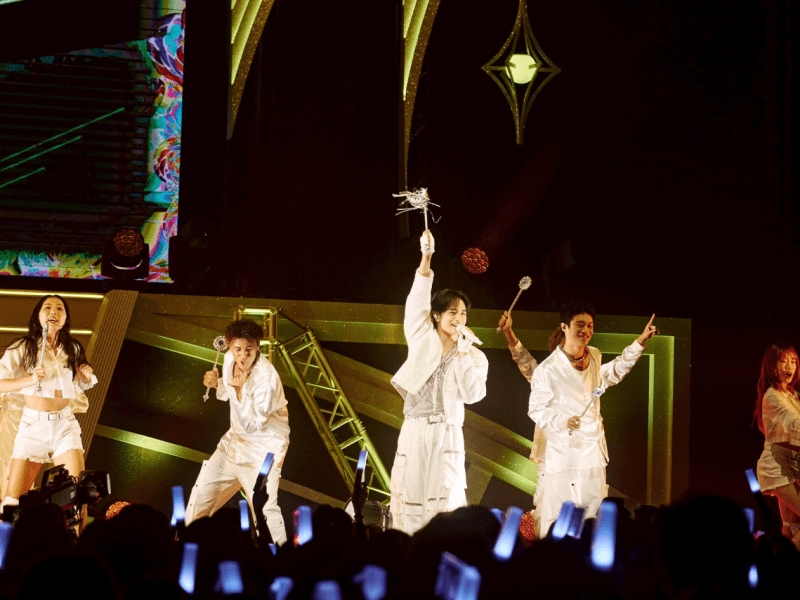
The music video leans fully into this mythology. Naomi radiant in white, luminous and expansive. Kento in shadowed black, sculpted and sharp. Their dance scenes are not decorative; they are confrontational, almost ceremonial. The choreography feels like a wager. A challenge issued in elegance rather than aggression.
When Naomi first saw the choreography, she admits she wondered whether she could pull it off. But watching him commit—fully, unapologetically—she decided to match that energy. If he was going to raise the temperature, she would raise it with him. The result is not hesitation. It’s combustion.
What makes the pairing extraordinary is not contrast alone. It is trust.
They do not cancel each other out. They amplify. His lower register coils beneath her clarity. Her brightness cuts cleanly through his darkness. Fans who thought they knew both artists find themselves startled—by how natural the harmony feels, by how addictive the rhythm becomes, by how quickly the replay button loses all meaning.
The chorus itself moves like an incantation. Light ignites. Darkness answers. The game fractures and reforms. The repetition doesn’t feel accidental; it feels ritualistic, like two forces summoning each other into being. It is less a pop hook than a spell — a reminder that in this universe, divinity is not static. It is performed, challenged, and reborn in rhythm.
And then there is the larger frame: IDOL1ST.
This second album is described as a collection that interprets “idol” from every possible angle — pride, evolution, self-production, reinvention. It includes the already-released “XTC,” lavish physical editions, re-recorded solo songs from his group era, and even a brand-new classic idol anthem tucked into the regular edition. Nothing about it feels minimal. It feels like a thesis.
“Gods’ Play” sits inside that thesis like a crown jewel.
Because collaboration, for Kento, has never meant dilution. It has meant expansion. Each time he works with someone new, he reveals a facet that feels surprising yet inevitable. Naomi does not soften his world. She elevates it. He does not overshadow her brilliance. He frames it—then dares it to overpower him.
There is also something quietly tender beneath the grand imagery. He speaks of challenging the “world’s goddess” Naomi, but the tone is layered with admiration. She laughs about how much fun the collaboration was. He praises her voice. She praises his presence. Behind the gods and dice and celestial theatrics are two artists who have known each other long enough to root for each other without ego.
Perhaps that is why the fantasy works.
And then there are the penlights.
When his custom penlights appear onscreen, they’re no longer just a concert accessory. They’re relics. Sacred instruments reframed as divine tools within the mythology. What once guided arenas now glows like celestial weaponry. It’s a subtle but deliberate gesture toward U:nity, an acknowledgment that the audience has always been part of the architecture. The world he builds does not exist without the hands that once lifted those lights, a true unity.
Because it is grounded in something real.
The imagery of gods playing in an elegant, unpredictable world could have tipped into excess. Instead, it lands as immersive. You believe they are powerful enough to inhabit it. You believe the dice matters. You believe the clash.
And yet, when the music fades, what lingers isn’t the competition.
It’s the shared ascent.
“Gods’ Play” is not simply about light versus darkness. It is about two people who have walked their own paths long enough to meet again at a higher plane—no longer as variety show co-stars, no longer as parallel names in the industry, but as equals in a universe they built together.
If fate is decided by dice, then perhaps this collaboration was inevitable.
Not because gods decreed it.
But because two artists kept moving forward until their timelines aligned.