
From January 23–25, Kento Nakajima brought his solo concert series “THIS IS KENTY -IDOL ver2.0-” to Tokyo’s Ariake Arena, drawing a total of 60,000 fans across four performances. The January 25 final was a night that crystallized not only the scale of his ambition as a solo artist, but the philosophy guiding this next chapter of his career.
At its core, IDOL ver2.0 is not simply a live tied to releases. It is a fully articulated concept show built around Kento’s second single “IDOLIC” and his upcoming second album IDOL1ST (out February 18). The question it asks—what is an idol, really?—is answered not through words alone, but through structure, visuals, collaboration, and emotional transparency.
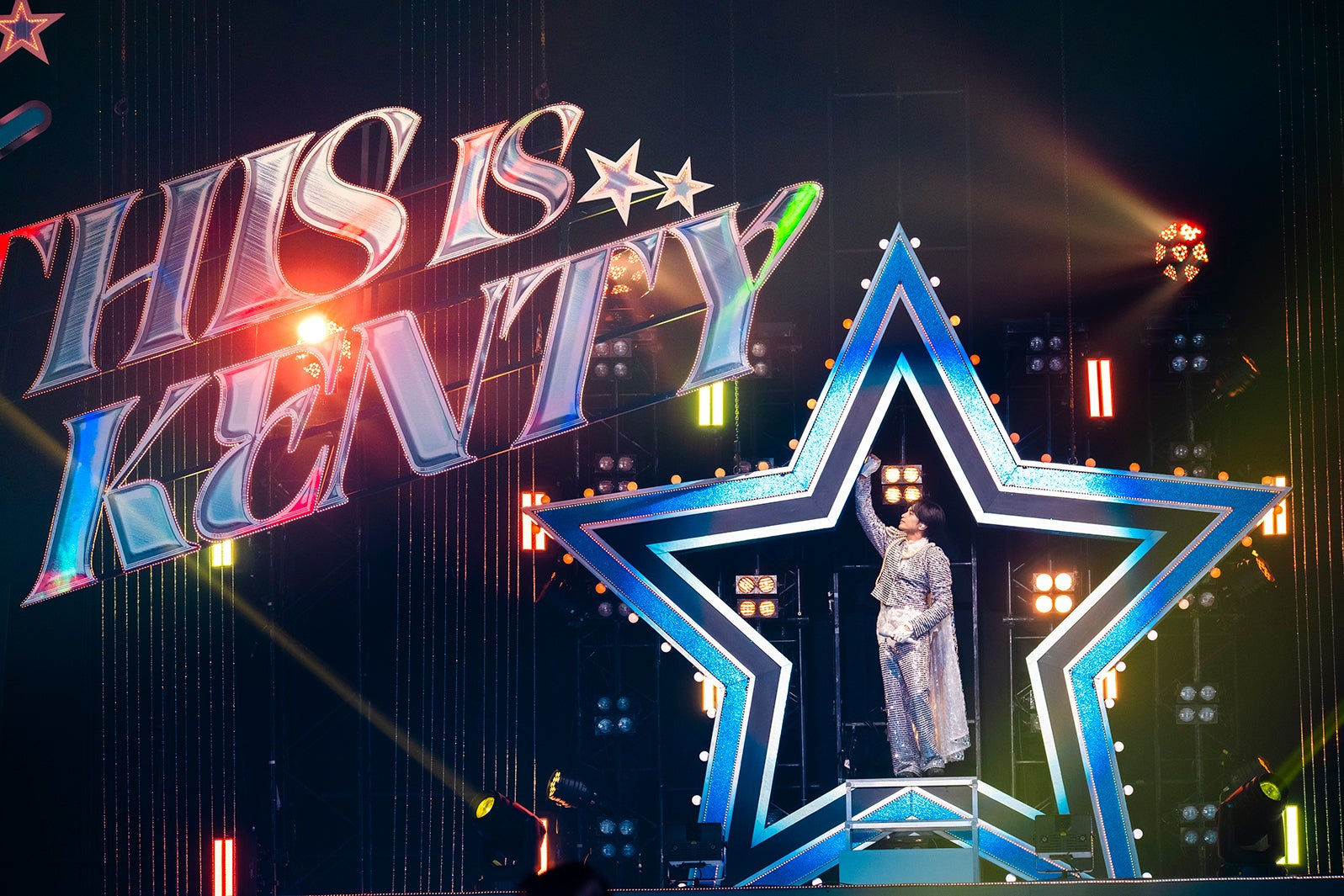
Building the “ultimate idol”
The concert opens like a piece of narrative theatre. On screen, a researcher attempts to create the “ultimate idol,” failing repeatedly until arriving at one conclusion: what is missing is ai—love. That love is drawn from the audience itself. As U:nity’s heart-shaped, wing-motif light sticks glow across the arena, Kento is “born” from a suspended beaker above the stage.
From the first notes of “IDOLIC,” the message is clear. This is idolhood as something reciprocal—something generated between performer and audience, not manufactured in isolation. Feathers fall, sequins catch the light, and Kento declares reunion with his fans: “We finally meet, U:nity.” The show does not ease in; it commits fully from the opening moment.
The stage design reinforces this intent. Stars, wings, flying rigs, and laboratory imagery merge fantasy with control, spectacle with intimacy. Even the smallest details—such as the customizable card-insert light sticks—underline how deliberately Kento has shaped every element of this experience himself. What became clear over the course of the night was that the audience recognized this authorship as well: the mechanisms were not read as gimmicks, but as parts of a shared language, understood and activated collectively by U:nity.
Across nearly three hours and 25 songs plus triple encore, Kento moves fluidly between modes: confident pop, restrained balladry, sharp EDM, and high-energy dance tracks. Songs like “Unite,” “jealous,” “Can’t Stop,” and “SUPERNOVA” highlight his command of tempo and atmosphere, while “モノクロ” and “迷夢” place emphasis on vocal clarity and emotional restraint.
Midway through the show, Kento performs the cheering song for his international drama Concordia: “THE CODE,” an all-English EDM track, backed by precise formation dancing that emphasizes discipline and global ambition. Later, “Mission” (literally) strips that polish away, leaning into physical intensity and raw momentum. These contrasts are not accidental—they underline the breadth of what he considers “idol expression.”
A notable emotional axis of the night comes through his interaction with the N’s Junior, the younger performers supporting the show. Even from the upper tiers of the arena, the intent of these moments translated clearly—scale never eclipsed connection. Kento not only spotlights them through MC segments, but also gifts them an original song, “アイドルになった日,” which he wrote, composed, and choreographed himself. Framed as a message to the next generation, the moment ties his own Junior-era memories to his present position—not as a distant senior, but as someone actively extending a hand forward.
Gratitude, bonds, and resolve
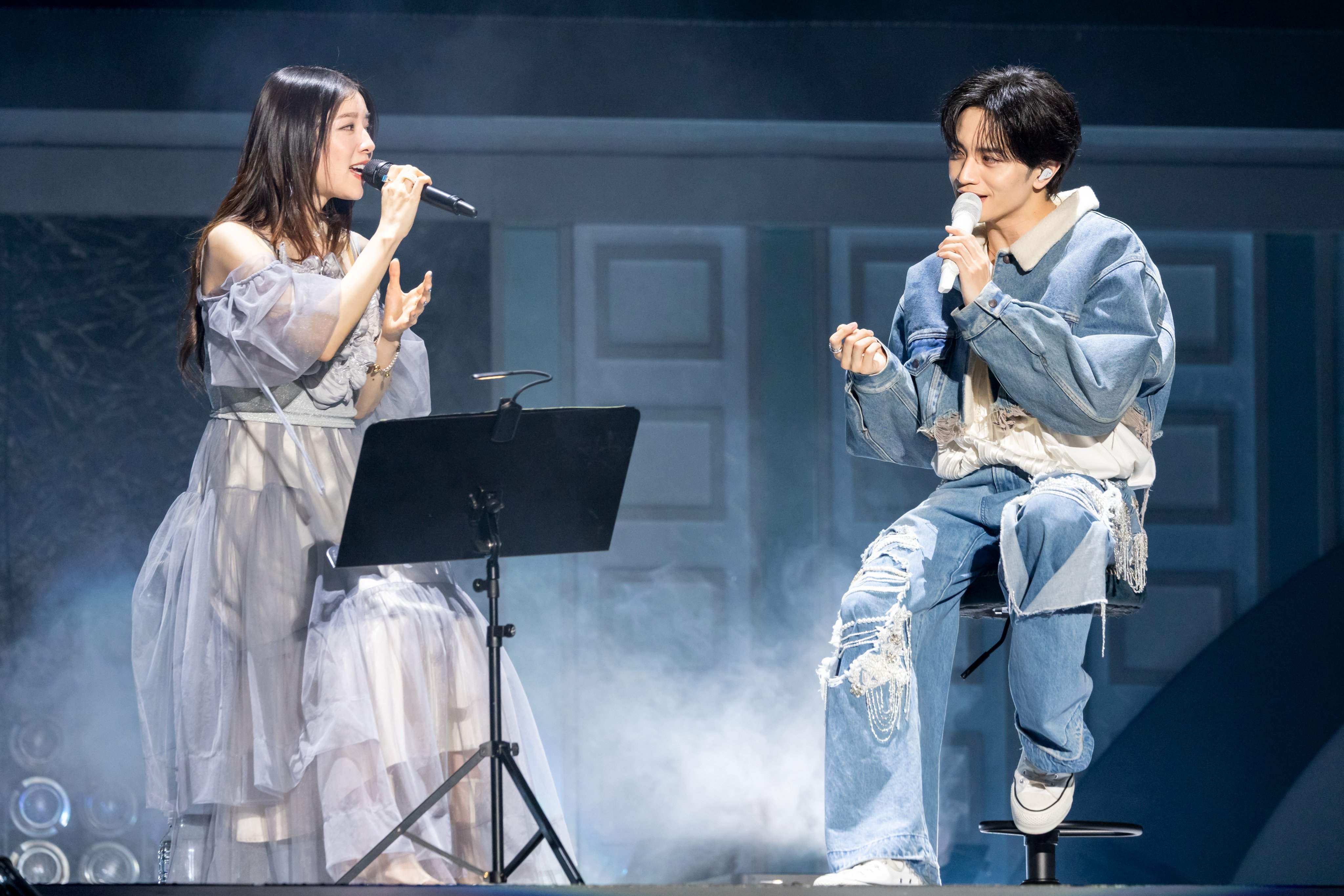


One of the defining features of the Ariake run was a rotating secret guest segment, with a different collaborator appearing at each performance. Across the four shows, audiences saw appearances from Kocchi no Kento, Mori Calliope, and milet, each tied to an existing creative connection rather than assembled for surprise alone.
Kocchi no Kento, whose previous collaborations have become a hot topic, appeared and performed “Hai Yorokonde” and “HITOGOTO for nounou.” Together with Mori Calliope, they extended their cross-virtual collaboration into a live arena setting, performing “Gold Unbalance“ and “Fatal.” milet, who co‑starred with Kento in the film My Beloved Stranger, brought a cinematic emotional continuity to the stage through their joint performances.
Seen together, the guest selections traced Kento’s recent creative relationships across music, virtual collaboration, and acting—positioning the segment as a map of his expanding artistic field rather than a series of isolated cameos.
The final night, however, carried particular emotional weight.
As the familiar guitar intro of “BAD BOYS” rang out, the arena erupted. Daiki Shigeoka (WEST.) and Hikaru Iwamoto (Snow Man)—Kento’s long-time best friends and co-stars from BAD BOYS J—appeared on stage in leather jackets, reviving their shared past.

What followed was not staged nostalgia, but visible comfort. Their MC reflected an ease and familiarity rooted in long-standing friendship; rehearsal stories were shared without polish. Kento then unveiled “スリーマンセル” (Three-man cell), a brand-new song written specifically for the three of them and performed publicly for the first time that night. Fast, rock-leaning, and emotionally direct, the song translated private bonds into a shared spectacle—without diluting their sincerity.
They returned again for the encore, joining “CANDY ~Can U be my BABY~,” walking the runway with oversized light stick balloons and openly enjoying the chaos. It was playful, loud, and unmistakably human.
If THIS IS KENTY -IDOL ver2.0- had one emotional throughline, it was gratitude. That gratitude was not only spoken, but structurally embedded—through synchronized audience cues, repeated call-and-response moments, and the ease with which Kento’s humor and offhand remarks drew the room into a single rhythm.
Kento spoke candidly about the loneliness and uncertainty that followed his new start as a solo artist. Reflecting on that period, he admitted, “I’ve always lived seriously as an idol. After starting anew, there were so many twists and turns. I kept thinking—why isn’t this getting through, how can I make it reach people? I’d be in the rehearsal room alone, suddenly realizing I was standing there by myself in front of the mirror.” He went on to describe nights without sleep and moments when he couldn’t even bring himself to look at his phone, before grounding his experience in gratitude toward his fans. “Even then,” he continued, “the thing that shone a light on my life as an idol was the people who love me— U:nity.“
That honesty culminated in a declaration that drew one of the loudest reactions of the night: a promise to stand on the Tokyo Dome stage within two years. Recalling his appearance at the recent countdown concert—where he stood alone among groups yet was met with overwhelming cheers—Kento articulated a realization that would define the night: being solo did not mean being alone.
Framed not as bravado but as conviction, he reflected on the uncertainty that marked the early stages of his solo journey—nights spent questioning whether his ideals could truly take shape, moments of isolation in rehearsal rooms, and the emotional weight of standing alone at shared milestones. What sustained him, he emphasized, was the unwavering support of U:nity, which he described as the light that continued to illuminate his path as an idol.
He also looked back on standing alone at the recent countdown concert, surrounded by groups yet receiving a sea of cheers, a moment that clarified something essential: being solo did not mean being solitary. “I realized then that I might be one person, but I’m not alone,” he said. “So I’ll take everyone with me. Within two years, I will stand at Tokyo Dome.”
The final moments of the concert reinforced this sense of continuity rather than closure. After multiple encores and persistent fan calls, Kento returned once more to perform Sexy Zone’s “Kimi dake FOREVER.” It was a quiet acknowledgment of where he came from, offered without hesitation or defensiveness.

What is an idol, really?
Taken together, these choices point toward a broader answer.
Throughout THIS IS KENTY -IDOL ver2.0-, Kento offers a clear answer to the question at the heart of the production—not through declaration, but through practice. As a solo artist, he does not distance himself from the word idol, nor does he attempt to redefine it by shedding its history. Instead, he doubles down on it, treating idolhood as a discipline built on intention, continuity, and responsibility.
In Kento’s framing, an idol is not simply a performer or a personality, but someone who actively chooses to shoulder emotion—his own and that of the audience—and give it shape. That choice is visible in how meticulously he constructs his work: from concept-driven staging and audience participation, to mentoring Juniors, to collaborations rooted in genuine creative history rather than novelty. It is also why his music resists being contained within a single genre. Rather than allowing sound or style to become the defining feature, Kento treats music as one of many building blocks—an expressive tool that serves a larger identity rather than the core that replaces it. Each element reinforces the idea that being an idol is not about fixation on form, but about commitment sustained over time.
Crucially, Kento’s solo identity does not reject collectivity. Even as he stands alone on stage, his work consistently pulls others into focus—fans, Juniors, collaborators, and past selves included. Idolhood here is not about isolation or self-mythology, but about remaining legible and present to others, even as one’s role changes.
In that sense, THIS IS KENTY does not argue that idolhood is something to outgrow. It suggests the opposite: that choosing to remain an idol, consciously and without irony, is itself a form of resolve.

THIS IS KENTY
THIS IS KENTY -IDOL ver2.0- is not about reinvention for its own sake. It is about definition—about deciding, with intention, what idolhood means now, and refusing to separate spectacle from sincerity.
By the end of the Ariake Arena final, that definition felt clear: an idol shaped by gratitude, sustained by collaboration, and unafraid to place love—openly, almost recklessly—at the center of everything.
If this is Kento Nakajima’s version 2.0, it is not an upgrade that erases the past. It is one that carries it forward, brighter and more deliberate than before.


![[GIVEAWAY!] IDOL1ST Kento Nakajima” LIVE TOUR 2026 Goods](https://dumplingbox.org/wp-content/uploads/2026/07/idol1st-giveaway-1200x900.png?crop=1)

