
Kento Nakajima has never hidden his desire to take his storytelling beyond its borders. Not to leave it behind, but to carry its texture, discipline, and emotional precision with him onto a larger stage.
As the world rediscovers its appetite for samurai epics — for stories shaped by steel, loyalty, and moral fracture — Japan is not simply watching from the wings. It is stepping forward. HBO Max’s acquisition of Song of the Samurai, a live-action adaptation of Chiruran: Shinsengumi Requiem, signals more than another period drama entering the global pipeline. It marks a shift in who gets to carry these stories outward.
The global momentum is undeniable. Shōgun reignited Western fascination with feudal Japan, proving that historical Japanese narratives could dominate global conversation. A second season is already in motion, with Ren Meguro (Snow Man) stepping into that expanding world. Meanwhile, Last Samurai Standing (streaming on Netflix) continues to demonstrate that Japanese-led productions can command international attention, with veterans like Junichi Okada and Kazunari Ninomiya anchoring its gravitas.
Beyond the samurai resurgence, contemporary thrillers like Alice in Borderland have built massive international fandoms, while emotionally charged survival dramas like Pending Train — starring Joichiro Fujiwara of Naniwa Danshi — have underscored how boldly Japanese television can imagine catastrophe, connection, and hope under pressure.
At the same time, the Netflix adaptation of the live-action ONE PIECE phenomenon — though produced outside Japan — also speaks loudly of the worldwide hunger for Japanese-born stories. Even older Japanese dramas are finding renewed life on streaming platforms, rediscovered by new generations with subtitles at the ready. The appetite is no longer niche. What was once treated like a hidden secret is now slowly becoming globally accessible. The doors are not just opening — they are staying open.
This rise has not come without memory. Western skepticism toward live-action adaptations still lingers — shaped by misfires like Dragonball Evolution or the 2017 American Death Note, projects that stripped beloved stories of their cultural core. And yet, within Japan itself, live-action adaptations have quietly built a far steadier legacy. Franchises like Kingdom, Golden Kamuy, and Cells at Work! have demonstrated that when handled with cultural fluency and narrative respect, these adaptations can thrive. The difference has never been the material. It has been the stewardship.
But for Kento Nakajima, this moment is not just about genre resurgence. It is about a long-stated global ambition — his desire to step onto the world stage, not to blend in, but to bring his own brand of Japanese entertainment and presence with him.
Long before swords and period uniforms entered the conversation of going global, Kento was quietly shaping himself into an actor with global fluency. His career has always existed at an intersection: idol and performer, polished and searching, charismatic yet restless. Acting, alongside his life as an idol, did not merely run parallel — it refined him. It forced him inward. It sharpened instinct into craft.
If there is a thesis to his evolution, it is this: expansion without erasure.
His first major step into Netflix territory, Love Like the Falling Petals (2022), introduced him to a worldwide streaming audience. The film’s fragile intimacy — a love story shaped by time and loss — required restraint rather than spectacle. Kento met it with softness, allowing silence to do as much work as dialogue. And when he later sat down for interviews with Netflix, speaking in English, it was more than promotional polish. It was a signal. He was preparing to be understood beyond subtitles.
Even earlier, in She Was Pretty (2021), he slipped English lines into his performance with playful confidence — small moments, perhaps, but revealing ones. They suggested comfort stepping outside linguistic borders, an instinct to stretch toward something wider.
Then came My Beloved Stranger (2025), a Japanese remake of the French film Love at Second Sight (Mon Inconnue). Adapted from a European romantic fantasy, the project itself was a cross-cultural bridge. Screened overseas and made available with English subtitles on platforms like Viki and Netflix in select regions, the film extended Kento’s presence into international viewing spaces. It placed him within a narrative framework already familiar to Western audiences — a subtle rehearsal for crossover storytelling.
Fragments of the Last Will (2022)(streaming on Netflix in certain territories) premiered at the 35th Tokyo International Film Festival and later screened at the Japanese Canadian Cultural Centre. Despite a smaller role in the movie, the role still gave him a foothold on screens, slowly traveling outside Japan.
Outside of scripted sets, his relationship to cinema itself has also grown more visible. Through WOWOW’s film travel program Kento Nakajima: The Movie Traveler, he has journeyed across countries to meet filmmakers and immerse himself in local film cultures. In the program’s very first season, he traveled to Bengaluru, India, stepping into the world of Sandalwood and speaking directly with director Prashanth Neel about heroism, spectacle, and the emotional architecture of Indian action cinema. “For me, Indian films were an unknown territory,” he reflected. “But there was a world of dreams and passion there.” Experiencing a film industry that thrives outside the Hollywood axis left a visible impression on him. As he put it with a smile, this was “another sacred place of cinema — not Hollywood.”
The second season’s final episode brought him not overseas, but to Yamagata for the Yamagata International Documentary Film Festival — one of Asia’s largest documentary festivals. There, surrounded by volunteers, directors, and decades of film history, he reflected on how cinema connects people beyond language. “I’ve traveled to many places overseas,” he shared, “but I wanted to close the last chapter in Japan.” It was a telling sentiment. Even as he looks outward, he chooses to anchor himself at home.
And then there is Concordia.
Unlike his previous projects, Concordia (streaming on SkyShowtime) moved him decisively outside the familiar scope of Japan and broader Asia. Despite how firmly Japan remains his foundation, Concordia elevated him onto a distinctly international stage — not just geographically, but artistically and professionally. An international production with European collaboration, it demanded adaptability — culturally, linguistically, emotionally. It is difficult to overstate what that kind of environment does for an actor raised within Japan’s tightly structured entertainment system. It disrupts rhythm. It challenges reflex. It requires reinvention.
In an interview with the Swedish-Japanese Performers Association, Kento spoke candidly about what that reinvention required of him: “I pushed myself to do well with the English script and hope that this experience allows people to know about actors from Japan and maybe even to become interested in other Japanese films and TV dramas I’ve been in.”
That statement reveals something essential about him. Concordia was never just a personal leap — it was a bridge. A deliberate effort to widen the doorway, not only for himself, but for the industry that shaped him.
When asked about the similarities between himself and his character A.J., Kento answered with disarming honesty: “I think A.J. and I have some similarities, perhaps more than anything in how both of us are perfectionists. I want to do everything perfectly, but of course, some things don’t go quite as perfect and when such happens, I can have very human reactions to it. On the other hand, there are other aspects in which I think we are the exact opposite; for example, I would like to think I’m not as arrogant in real life, nor as scarily ruthless as he is.”
There is vulnerability in that admission — the perfectionism, the humanity when things fall short. It mirrors the very arc of his career: disciplined, ambitious, occasionally self-critical, but always striving. Concordia did not simply place him on an international set. It exposed his edges — and in doing so, strengthened them.
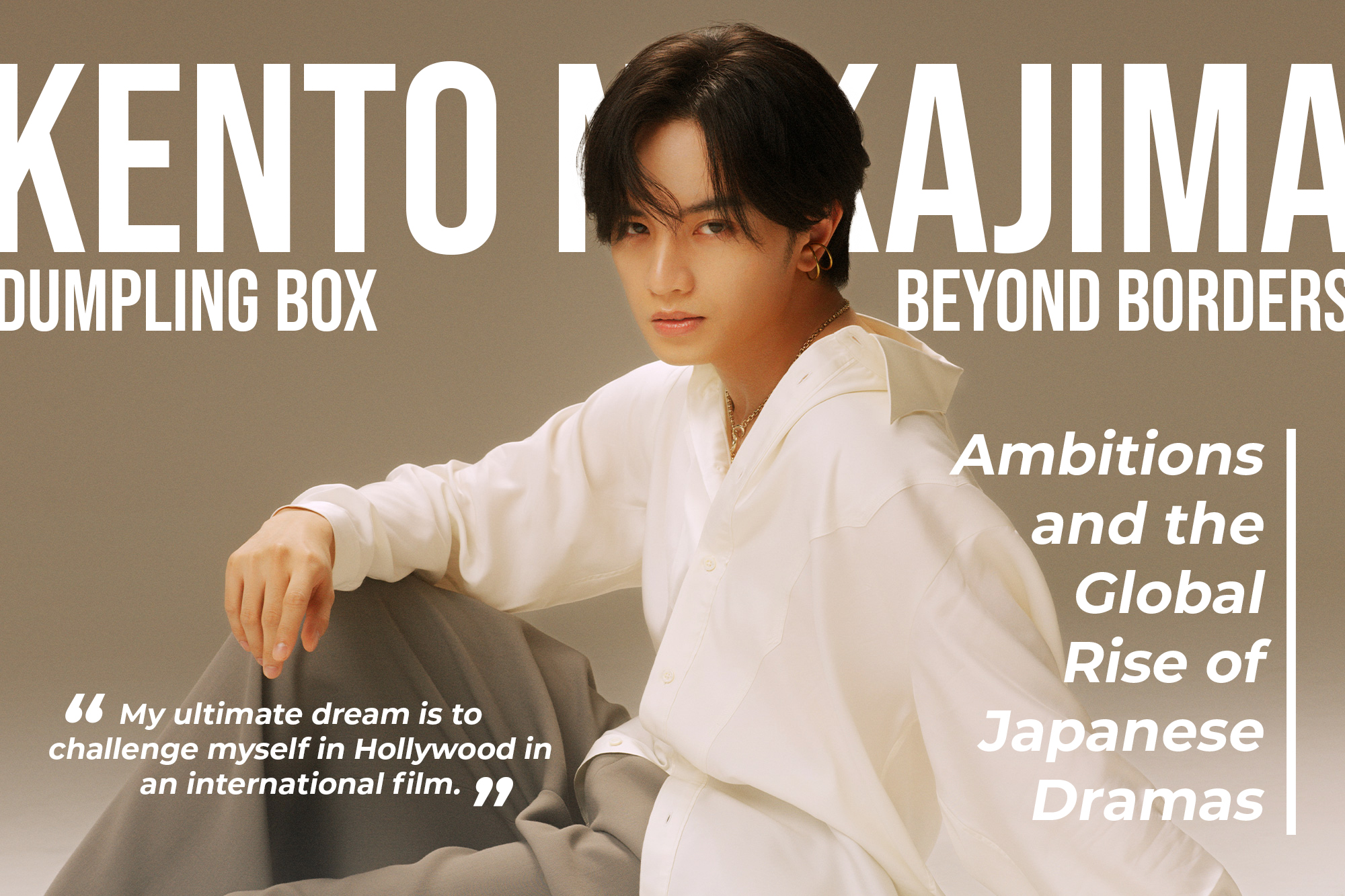
Kento’s desire for Hollywood exposure has never sounded like escapism — it has been visible in action, from delivering interviews in English for Netflix to pushing himself through the demands of an English-language script in Concordia. In the conversation with the Swedish-Japanese Performers Association, he was even more direct: one of his two specific goals for mastering English is Hollywood itself. “My ultimate dream is to challenge myself in Hollywood in an international film,” he shared, recalling a brief but unforgettable exchange with director Christopher Nolan at the Academy Awards, where Nolan kindly invited him to do a quick audition. He laughs that he is “still waiting for his call,” but the aspiration is sincere.
And yet, Hollywood is only half the vision. His second goal is just as telling: to use his English ability to make Japanese works more famous overseas. Having seen how Love Like the Falling Petals resonated in several European countries, he has spoken about wanting Japanese films and dramas to achieve the same household recognition that other Asian works have gained through streaming power. It sounds like responsibility — to his craft, to the stories that shaped him, and to the industry that raised him. Not a rejection of where he began, but a determination to carry it outward intact.
For someone who has openly shared that his dream is to become one of Asia’s top actors, to challenge himself in Hollywood in an international film, and to one day stand at the center of a big-scale action project, Concordia felt less like experimentation and more like a declaration.
What makes this particular moment — as Japanese dramas collectively secure lasting space on global platforms — feel pivotal is how naturally it connects to everything he has already done. He is not leaping blindly toward Hollywood, nor is he trying to become a version of someone else. He is carrying his own rhythm with him — inviting Hollywood, and the wider world, to experience Japanese storytelling through his charm, his discipline, and the distinct aura only he can bring through his acting and stage prescence.
And perhaps that is the most compelling part of his story. As Japanese dramas and music culture surge in newfound global popularity, Kento stands positioned within both worlds: the actor shaped by idol discipline and domestic storytelling, and the performer steadily calibrating himself for international scale. He carries the polish of an idol, the introspection of a dramatic lead, and the ambition of someone who understands that visibility is not the same as legacy.
The dream of becoming one of Asia’s top actors — and seeking meaningful Hollywood exposure on his own terms — does not begin in a city abroad. It begins in preparation. With every role — romantic, historical, fantastical, international — Kento has widened his horizon without abandoning his roots.
Now, as the world looks east once more, he does not need to chase the spotlight.
He has built the road toward it — and he is walking it on his own terms.


![[GIVEAWAY!] IDOL1ST Kento Nakajima” LIVE TOUR 2026 Goods](https://dumplingbox.org/wp-content/uploads/2026/07/idol1st-giveaway-1200x900.png?crop=1)

