
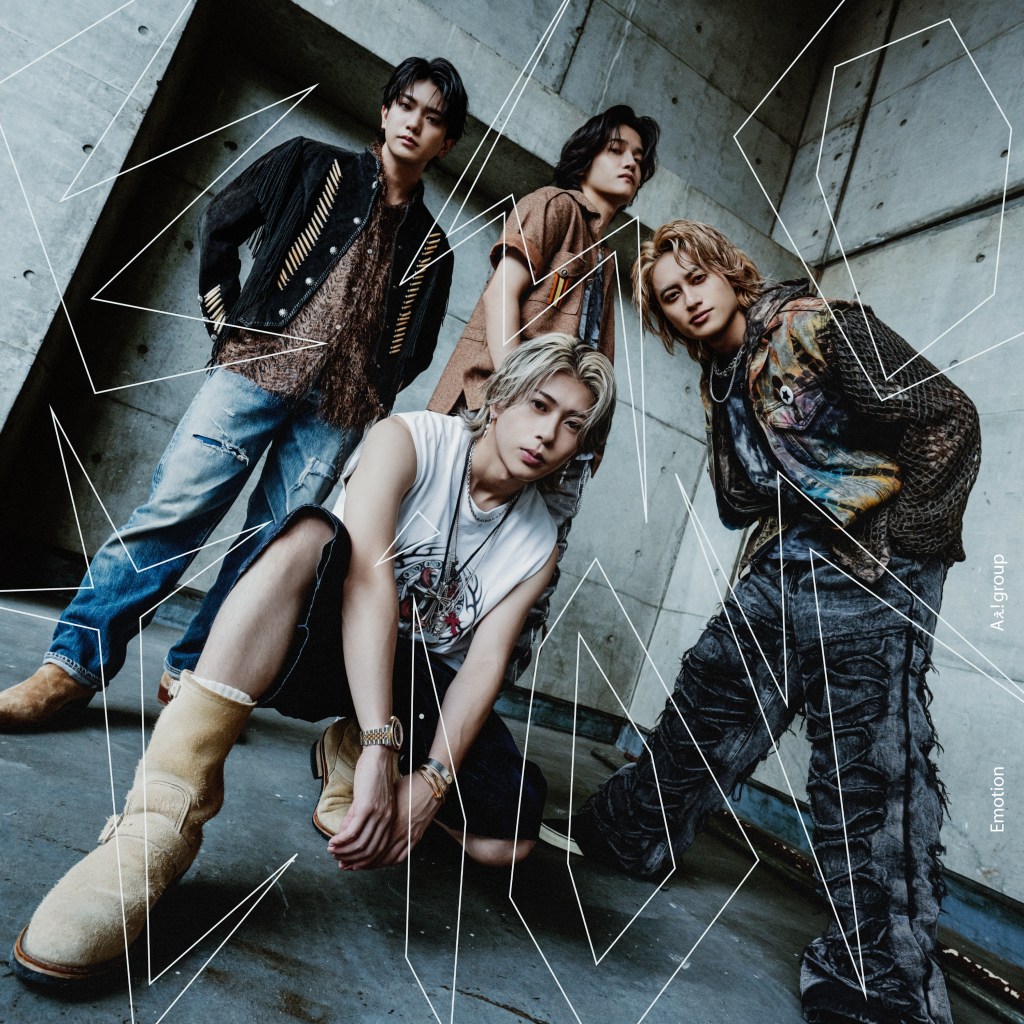
Following the long-awaited release of “PRIDE” and the evolution through multiple band songs, Ae! group’s “Emotion” feels like a turning point: the band is no longer waiting for its section of the concert. This time, the band song is the statement — with Seiya Suezawa standing unmistakably at the front.
emotion
/ɪˈməʊʃn/
An emotion is a complex conscious mental reaction or strong feeling—such as joy, anger, or fear—derived from one’s circumstances, mood, or relationships, typically accompanied by physical and behavioral changes.
It sounds almost tidy when written as a dictionary definition.
A definition. A reaction. A feeling given a name.
But emotions rarely arrive neatly separated from one another.
Sometimes pride hurts. Sometimes hope feels frightening. Sometimes frustration becomes fuel. Sometimes something makes you so happy that your chest aches anyway.
And sometimes you finish watching a music video knowing you should go to sleep, only to press play again.
Then again.
Then once more, because there was something in Seiya Suezawa’s voice you want to hear properly this time. Something Yoshinori Masakado did with the guitar you almost missed. A change in Ken Kojima’s keyboard. The force behind Masaya Sano’s drums. An expression between the four of them that disappeared before you could decide exactly why it affected you.
It evokes emotion(s).
So, let’s begin talking about “Emotion.”
Because for all the discussion that will naturally surround its technical difficulty, Ae! group’s growth as musicians, and the significance of placing a band song in the title-track position, what hits first is exactly what its name promises.
Emotion.
It is restless. Proud. Frustrated. Hopeful. And everything in-between. Almost desperate in its determination to keep going.
And, perhaps more than anything, it feels alive.
For those who just discovered Ae! group through “Emotion,” the song concept should not be framed as four idols suddenly reinventing themselves as musicians. Band performance has been one of the group’s defining weapons since their Junior years, something they deliberately developed in an era crowded with other groups searching for their own identity.
What has changed is where that weapon is being placed.
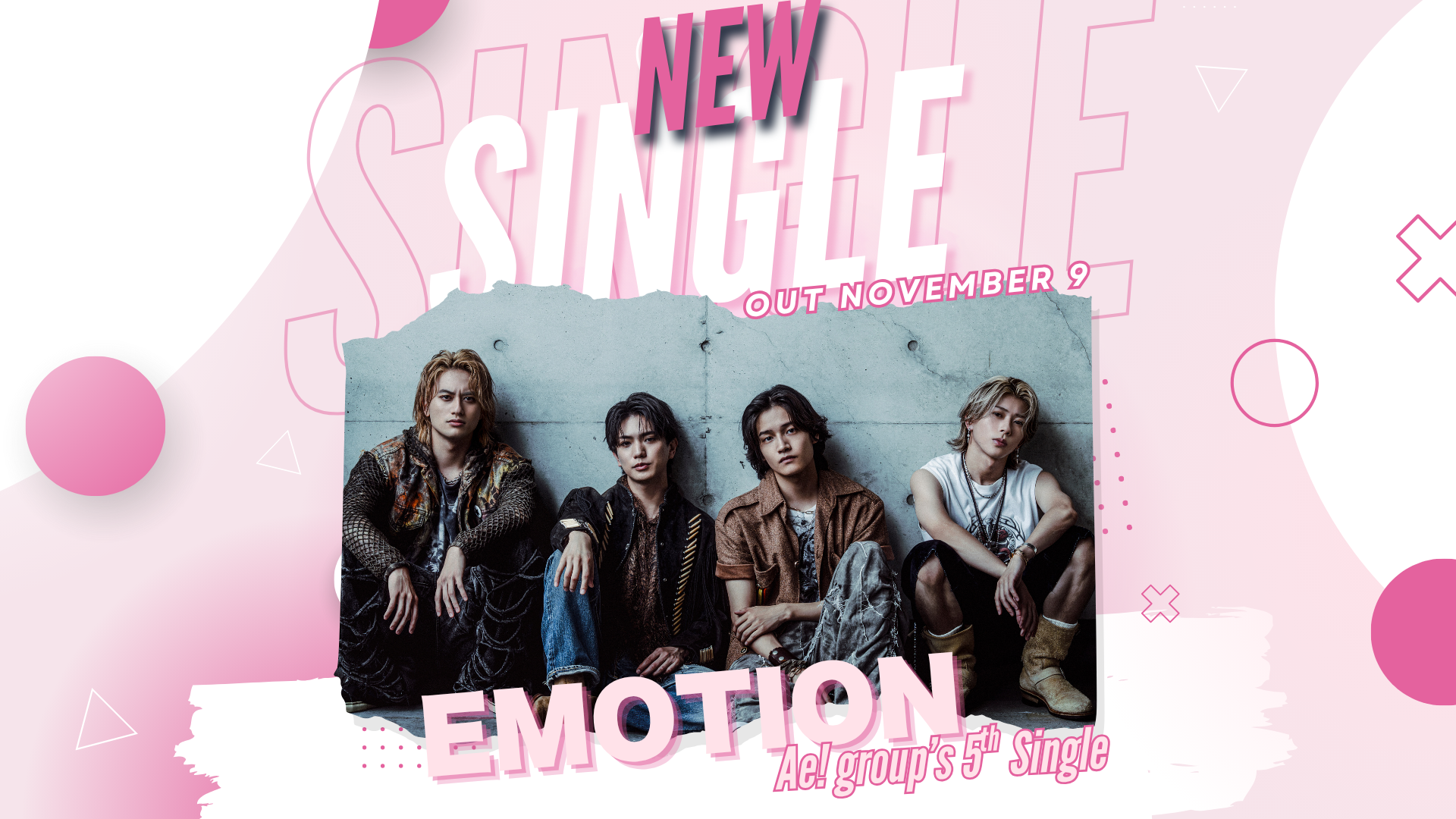
Universal Music introduced “Emotion” by emphasizing that Ae! group’s long-awaited band song was finally becoming a single title track. The group’s fifth single, due for physical release on November 4, therefore marks the first time since their CD debut that this side of Ae! group has been selected to represent the single itself.
That is the shift. Not that Ae! group are finally a band, but that they are finally allowing the band to introduce them.
Three months ago, Ae! group finally gave their band anthem “PRIDE” the official recording and music video fans had waited years to receive.
The song had followed them since their Junior era and had become something close to a calling card. A song fans always returned to when asked “What song do you think represents Ae! group?”
When discussing its importance, Masaya described “PRIDE” as the song that arrived when they began taking the band seriously enough to make it one of Ae! group’s weapons. Yoshinori called it something like a trump card; Ken described it as a song that helped establish what Ae! group was.
But between “PRIDE” and “Emotion” sits another important step: “Hoko” (咆哮), which proved that Ae! group’s band identity did not belong exclusively to “PRIDE” and their more pop-sounding band arrangements.
There is even creative DNA connecting the beginning and the present.
Like “PRIDE,” “Emotion” is written by Ryosuke Kawashima and composed by SAKUMARYO, with Sakuma and Shogo Onishi handling the arrangement.
Kawashima and Sakuma have previously spoken about trusting Ae! group enough to keep pushing the difficulty and refusing to smooth away the sharper, more aggressive parts of their music. Sakuma recalled the attitude around creating for them almost becoming: Ae! group can handle it.
The official description calls it an aggressive, solid rock number in which the members challenge themselves with playing of even greater difficulty, placing that instrumentation directly against what Universal describes as Seiya’s cutting high-tone voice.
Which brings us to how Ae! group has never depended on one permanent center. Yoshinori and Seiya have often functioned as a dependable double-center (as noted by themselves and fans alike), but the group’s identity has consistently depended on the whole. But when it comes to “PRIDE,” “Hoko,” and now “Emotion,” the center spotlight and individuality turn to Seiya.
His vocals do not sit politely on top of the arrangement. It fights with it.
Yoshinori’s guitar attacks from one direction, Masaya’s drums keep forcing everything forward, Ken’s keyboard adds another texture, and Seiya has to somehow cut through the middle of all of it.
His voice becomes another instrument—an instrument called the vocal.
And yet, making him the obvious frontman somehow does not make “Emotion” feel like a song with one protagonist.
Seiya is clearly the main vocalist, but the playing ability of the other three is strong enough that all four members remain vividly in your memory.
The magic behind “Emotion” and the other songs is led by Seiya’s incredible and unique stage presence and resonance. His vocals give the songs a focal point, but the force behind him belongs equally to the others.
These songs exist just because Seiya can handle them, because Seiya can turn everything that is “Ae! group” into his vocals and deliver it to anyone who listens. And the members trust him wholeheartedly to do so.
These are songs that ask an enormous amount of Seiya as a vocalist — because the others are giving him an enormous amount to sing against.
He is not pulling “Emotion” forward as its sole main character. He feels closer to a guiding light: the person entrusted to take everything the four members are creating together and project it outward through his voice.
And perhaps that is why his position feels so natural. The others trust him to stand there, while Seiya can trust that whenever he throws himself completely into the vocal, Yoshinori’s guitar, Ken’s keyboard and Masaya’s drums will still be there underneath him.
He does not have to shine brighter than the others.
He has to make their collective fire visible.
Fans have naturally begun connecting “Emotion” directly back to “PRIDE.”
Not because the new song copies it. Because it feels like it answers it.
“PRIDE” contains the declaration 「生まれ変わったって僕でいたい」 — wanting to remain yourself even if born again — while “Emotion” pushes that sentiment further with 「幾千と生を受けても 僕を選んでみせるよ」, choosing yourself no matter how many lives you receive.
Maybe that is why we keep replaying it — on the way to work, long after we should have gone to sleep, whenever we need something loud enough to push us forward and face the day.
A definition can tell us that emotion produces physical and behavioural changes.
“Emotion” makes that strangely literal.
We replay it. We sing louder. We want to see them live. We want to keep going with them.
Somewhere along the way, we stop simply watching Ae! group feel the song.
We feel it with them. And then we turn it up again.
Ae! group on social media
Don’t forget to follow Ae! group on all their official accounts to keep yourself updated with the recent news!



More Ae! group on Dumpling Box

![[GIVEAWAY!] Ae! group LIVE TOUR 2026 Runway Goods](https://dumplingbox.org/wp-content/uploads/2026/07/Featured-Image-Template_20260712-1200x675.jpg)






Something went wrong. Please refresh the page and/or try again.