
“A love letter to our company’s history, written by those who are its future.”
This single line captures the heartbeat of Junior Showcase 2025 新星 –SHINSEI– perfectly. With this production, SUPER EIGHT’s Tadayoshi Ohkura did not merely curate a stage—he reaffirmed his self-appointed mission as the guardian of “J-pop’s legacy,” placing that legacy directly into the hands of the next generation.
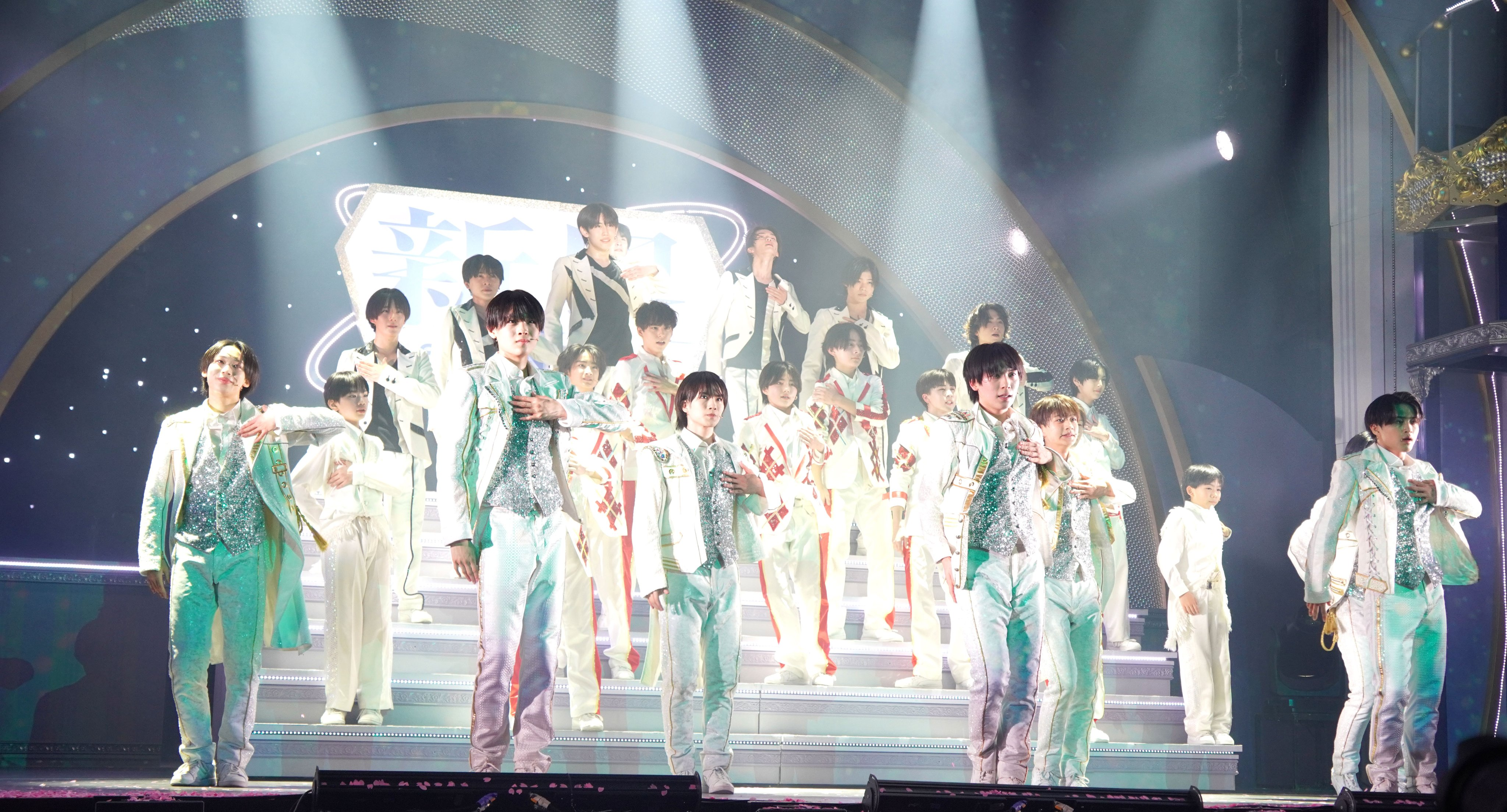
Opening on December 9 at Tokyo Globe Theatre, SHINSEI brings together 27 Juniors ranging from 12 to 20 years old, with an average age of just 16.2. Youth, in this space, is not framed as inexperience—it is framed as possibility. As history is inherited, the future is quite literally still growing into its limbs.
SHINSEI is not nostalgia for nostalgia’s sake. It is inheritance. It is a living relay between eras, where memory becomes movement, and history learns how to breathe again through new voices.
The program is densely packed with tributes—performances by fresh, up‑and‑coming Juniors that honor not only the signature songs of their debuted seniors, such as Hey! Say! JUMP’s “DEAR MY LOVER” and SixTONES’ “JAPONICA STYLE,” but also the very DNA of the company’s stagecraft itself. Threaded through the showcase are iconic show‑stoppers from SHONENTACHI, DREAM BOYS, TAKIZAWA KABUKI, and the legendary year‑end and New Year productions at the Imperial Theatre. These are not simple covers. As the boys dance, archival footage from those historic performances plays overhead on the backdrop screen—past and present layered together in real time. The result feels almost cinematic: a visual dialogue between generations unfolding on a single stage.
The show opens with a multi‑song tribute to SHONENTAI, a declaration of intent from the very first moment.
The opening sequence sets the tone immediately. Dressed in pure white suits, the Juniors emerge to perform “The Shining Star,” a song passed down through generations of seniors. In the prologue that follows, Jinsei Hamura speaks softly of the star inside the video—an idol who continues to shine no matter how many years pass.
“Inside this video is the star that means everything to me. A legendary idol. No matter how many years pass, they keep on shining. They are my stars.”
With those words, the curtain lifts fully on the SHONENTAI tribute. As footage of Kamen Butoukai plays on the screen, Kei Adachi (as Nishikiori), Kuto Chiino (as Higashiyama), and Taiga Watanabe (as Uekusa) appear wearing the actual SHONENTAI’s original costumes from the 1980s. Standing at vintage microphones, they mirror the original choreography in perfect synchronization with the projected legends above them.
At the press conference, Kei described the sensation as “light in material, but heavy with history,” and continued to speak of the pressure of dancing beneath footage of the originals, explaining how they performed with extra resolve so that today’s audience would truly watch them, not only the legends behind them. It is impossible not to feel the gravity of that choice. This is not imitation. It is succession.
The relay of history continues through timeless songs such as “Maitane Konya” and “Andalusia ni Akogarete,” before the stage erupts into physicality through the ~Chinese Martial Arts~ medley. Spears and swords flash through the air during Snow Man’s “EMPIRE” and the sweeping “Millennium Medley,” followed by the intense ~和‑殺陣~/Japanese Sword fighting segment where 19 Juniors perform traditional sword-fighting choreography amid palpable tension and dramatic audience interaction. Acrobatics from Masato Takemura tear gasps from the crowd, his movements slicing through the air with fearless precision.
In a lighter daily-revolving corner, individual talents shine through. Taisei Nabeta astonishes with continuous kendama tricks, while Koh Suenaga spins a hula hoop around his neck before seamlessly transferring it to his waist—his own surprised reaction mirrored by thunderous applause.
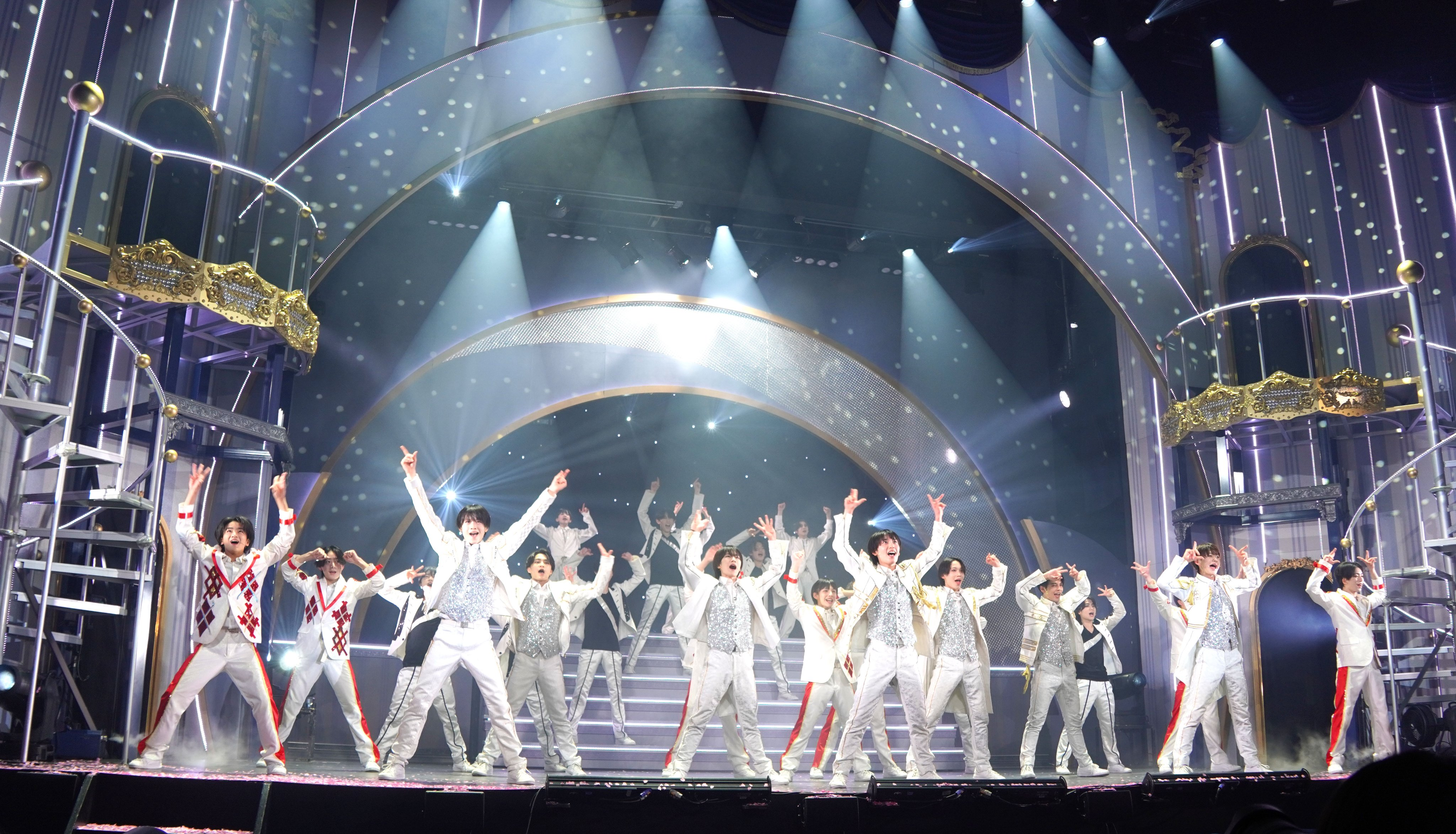
When asked about their approach to inherited choreography, Masato Takemura spoke about absorbing jazz foundations, control of tension, and the sharpness that defines classic STARTO stage presence. What emerges repeatedly is not just respect, but something closer to responsibility. These works are not being borrowed. They are being entrusted.
The stage soon transformed again, reviving the spirit of STARTO’s most iconic theatrical legacies. “Hirari to Sakura” from Takizawa Kabuki ZERO (the 2020 movie is available on Netflix) floods the stage with petals as Koh, Taisei, Kei, Kuto, Masato, Kaito Noda, and Taiga dance in pastel pink beneath a haze of falling blossoms. The emotional intensity spikes with “Yami wo Tsukinukete” from SHONENTACHI, as Juniors clad in red and blue recreate the rivalry once etched into the franchise’s identity. The baton continues through “NOT ENOUGH,” “Primavera ~Shakunetsu no Megami~,” and finally “DREAMER,” delivered by all 27 Juniors standing shoulder to shoulder—each face holding a different dream, but all walking toward the same future.
The contemporary segment brought the audience forward into the present era. ARASHI’s “Happiness” resonated through the hall with all 27 Juniors singing together, before Kansai representatives Taiga and Kaito took the center for Ae! group’s “WANT!!” The night closes with KAT‑TUN’s “Harukana Yakusoku” and the Junior anthem “Motto,” uniting the crowd in one final surge of voices and light.
By the final curtain, what lingers most strongly is not only the polish of the performances, but the intention behind them. This is a stage where children inherit weight, learn to carry it together, and slowly discover how to make it their own.

But perhaps one of the most impactful moments surrounding SHINSEI to fans was the announcement that Noa Asai, a former timelesz PROJECT -AUDITION- finalist and the youngest contestant to reach the final round, officially joined the Juniors through this stage. Ten months after the final judging, he steps forward again—this time not as a challenger, but as a member.
On stage, his presence was anything but tentative. He made a striking entrance during the ~和‑殺陣~/Japanese Sword fighting segment in a purple Japanese‑style costume, performing NEWS’ “KAGUYA” with a large parasol in hand, delivering even the song’s dramatic spoken lines with control. He later appeared in SMAP’s “SHAKE”—a former timelesz project challenge song—sharing the spotlight back‑to‑back with fellow Juniors, exchanging glances, taking center vocals, and demonstrating visibly sharpened strength compared to his audition days. He continued across the program with appearances in “Tokyo Experience,“ “Primavera ~Shakunetsu no Megami~,” and “Happiness.” This further reframed the idea of inheritance itself—that even a Junior who entered the world of STARTO by a different path could still return to the roots, taking up the same weight of legacy alongside those who had carried it for years.
His arrival inevitably shifted the internal temperature of the room. At the press conference, Kei and other Juniors admitted that his presence ignited a renewed sense of urgency—an unspoken we can’t fall behind energy. Initial hesitation soon softened into encouragement, and finally into rivalry that sharpened everyone involved. How they would catch Noa practicing alone in the corner with his earphones on, drilling choreography even when the room had otherwise relaxed. By the end of rehearsals, the tension had transformed into momentum. We are rivals, the mood conveyed—but we advance together, and now they all hang out together in the dressing room.
Tadayoshi also shared the quiet backstory behind Noa’s return. Though he had personally observed the timelesz PROJECT -AUDITION-, it was ultimately the company that reached out to Noa again after the final round—asking simply whether he still wished to challenge a career in entertainment. When they met, Noa’s answer was unwavering: he wanted to start from zero again—not as a finalist, not as a headline—but as a Junior.
Watching all of this from the producer’s seat, Tadayoshi also reflected on the difference between his era and theirs with a quiet smile. “They’re extremely capable. The level of performance is different,” he admitted—before immediately adding that in terms of raw spirit, his own generation never lost. And the Juniors quickly protested, “We’ve got plenty of fighting spirit too,” Tadayoshi laughed it off with a playful, “…so they say,” his expression betraying unmistakable pride, once again highlighting the unmistakably precious bond they have as a family within the agency.
When asked why he chose to build this project around the inheritance of senior stages, Tadayoshi explained that it began with a simple question: Wasn’t there a way to let today’s Juniors experience the stages and dances that shaped us? He remembers watching SHONENTAI and absorbing their choreography long before fully understanding its significance—and only later realizing how deeply that process had shaped him. Now, watching these children move naturally within that same framework, he sees the company’s unique performance language settling into new bodies all over again.
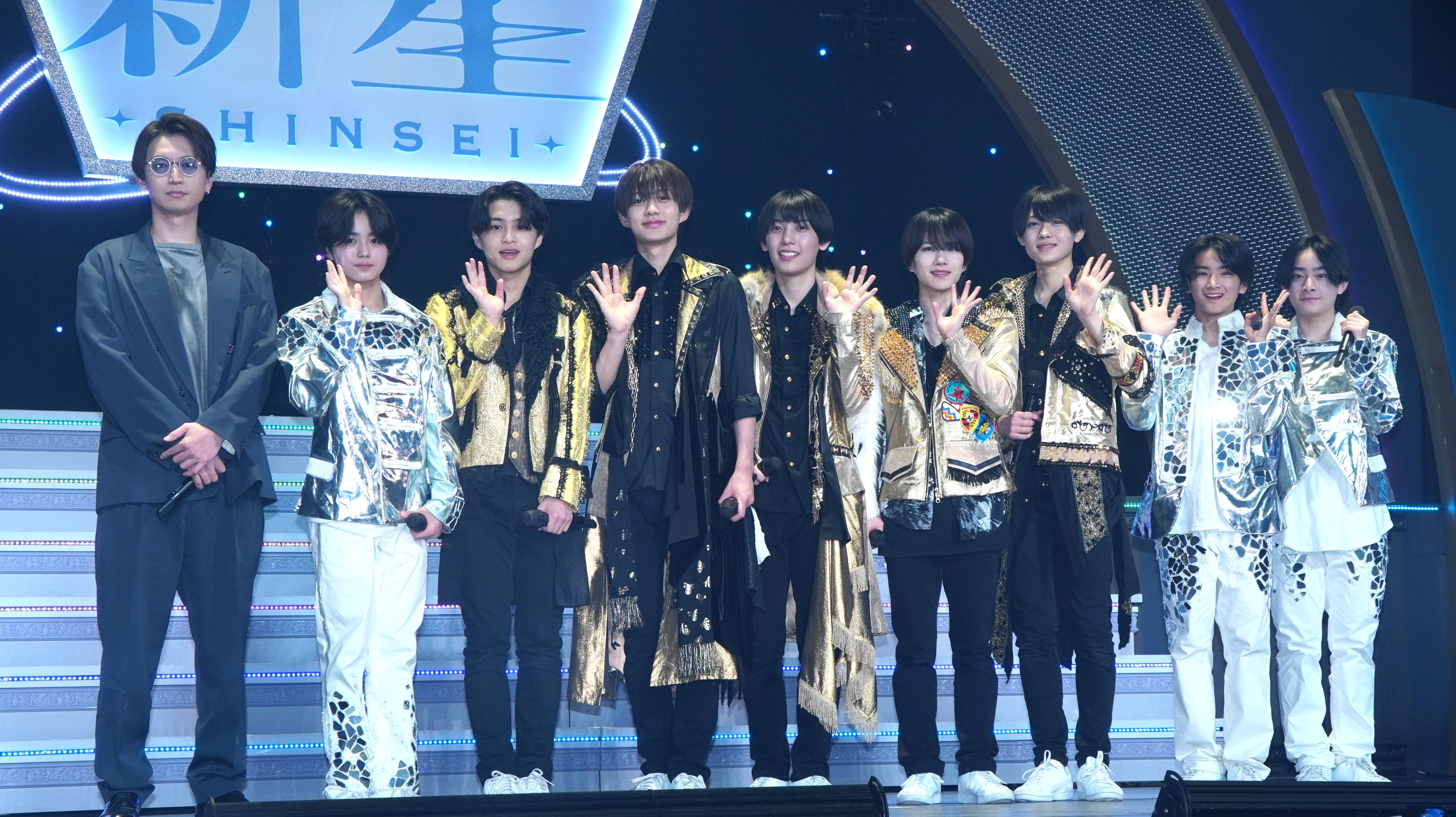
“They (the Juniors) looked so fresh. It honestly filled my heart,” Tadayoshi said fondly. “Some of them weren’t even born when our seniors were active. Even for us, when we were kids, dancing to senior songs didn’t always click right away.“
Listening to Tadayoshi reflect on his own days standing where these Juniors now stand felt quietly moving. It was clear that he understood, on a deeply personal level, what it means to face a stage like this—and why this cycle of inherited dreams and discipline is the legacy that must be carried forward.
“But years later, when you suddenly find yourself able to dance them naturally, it feels like the spirit of this company becomes part of you without even realizing it. I hope performing unfamiliar styles of dance helps them grow,” he concluded.
Among the younger members, fifteen‑year‑old Daia Miyaoka spoke nervously of standing on the same stage as performers up to eight years older, admitting that the sheer performance level of the older boys made him feel he couldn’t afford to relax. So Yamagishi, meanwhile, shared how seniors like Kei and Kuto advised him not just on technique, but on how to be seen—to think from the audience’s perspective, to allow maturity into expression. When Rai Zennyoji was asked whether Tadayoshi had given him any personal advice, his blunt “Not really” sent the room into laughter—prompting Tadayoshi to explain that Rai’s individuality was precisely why he preferred not to interfere. “I want him to keep living freely,” he said, half joking, half sincere.
The laughter faded into something quieter when the conversation turned to rehearsals. Performing alongside Tokyo Juniors, Taiga realized just how quickly even the youngest members moved—how fast they absorbed choreography, how swiftly they adjusted spacing, how naturally they read the room. Catching up, he admitted, was no small task. Kaito echoed that sentiment, explaining that while the atmosphere itself felt different from Kansai, the speed of understanding—the instant reaction power—was the greatest skill he took home. What began as regional difference became shared growth.
Junior Showcase 2025 SHINSEI does not simply frame the Juniors as “the next generation.” It shows them as the present—already standing on the same stage as legends once did, already carrying both memory and momentum in equal measure.
This is not the end of a story—it is the moment a new star (新星 (shinsei)) is born. Like a nova, these Juniors ignite from the weight of history itself, turning a love letter to the past into a blazing message from the future.
And behind that ignition stands Tadayoshi Ohkura—not as a distant producer, but as someone choosing, again and again, to stay close to the roots of what built him. SHINSEI is not just a celebration of what STARTO once was, but a declaration of responsibility toward what it will become.
By entrusting the company’s most sacred stages to children who are still learning how to stand in their own light, Tadayoshi makes one promise unmistakably clear that SHINSEI is “a love letter to our company’s history, written by those who are its future.”
The future of the STARTO Family will not be left to chance—it will be protected, challenged, and believed in—carrying the legacy of stars through generations to come.
More Junior Content on Dumpling Box
![[GIVEAWAY!] ACEes Arena Tour 2026 “V” Goods](https://dumplingbox.org/wp-content/uploads/2026/08/acees-v-giveaway-1200x900.png?crop=1)




![[GIVEAWAY!] B&ZAI LIVE 2026 Summer Beat Goods](https://dumplingbox.org/wp-content/uploads/2026/08/BZAI-giveaway-1200x900.png?crop=1)
Something went wrong. Please refresh the page and/or try again.