
As Zenbu Kimi no Sei da. (ぜんぶ君のせいだ。) arrives in Sweden for their 10th anniversary world tour, it marks more than just another overseas live date. It is part of a decade-long evolution — from underground alternative idol unit to Nippon Budokan headliners — built on one unwavering concept: yamikawaii (病みかわいい).
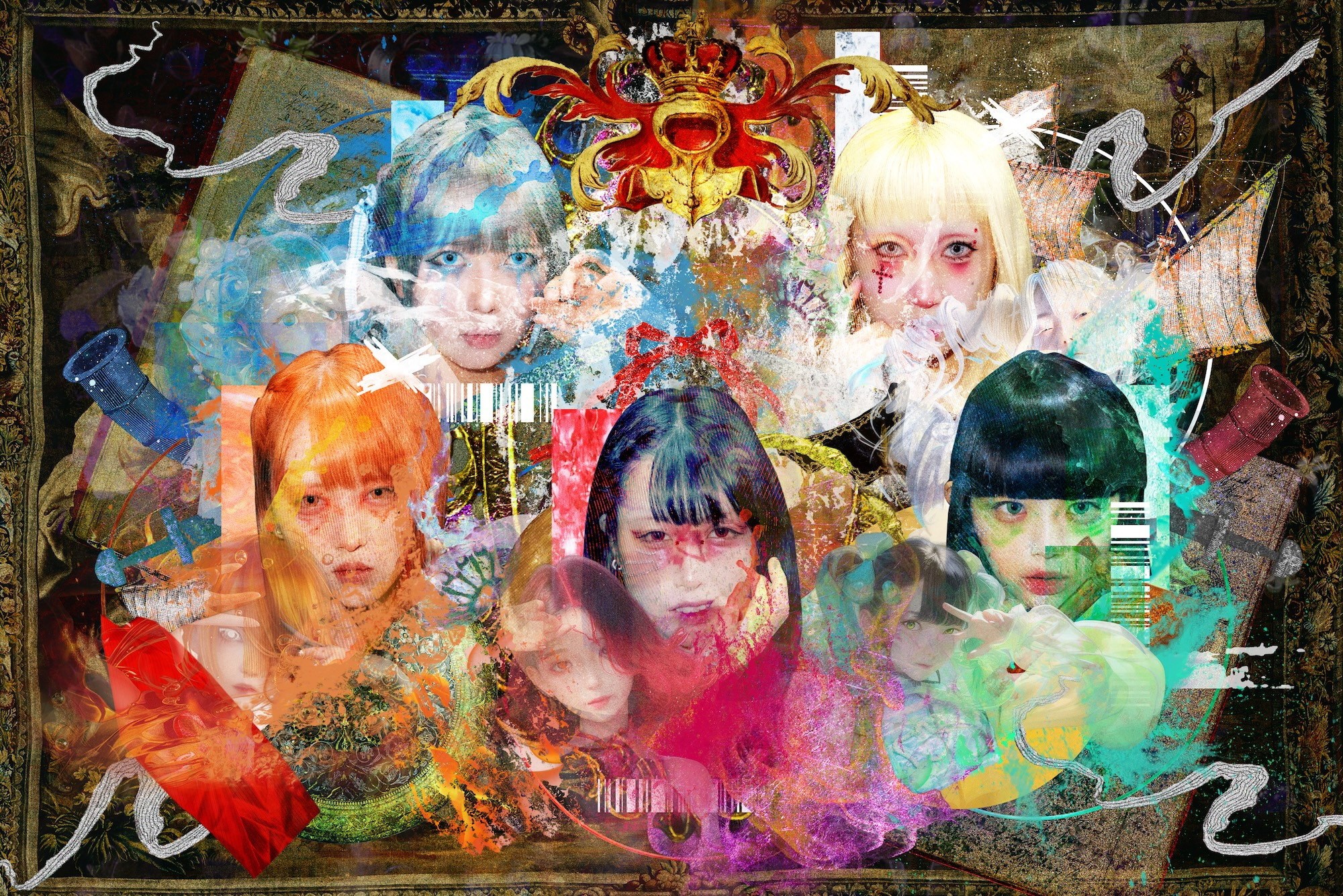
The group currently consists of Megumi Kisaragi (如月愛海), MeiYuiMei (メイユイメイ), Komochi Nene (寝こもち), Muku (むく), and Hikari Hino (煌乃光). Zenbu Kimi no Sei da. first debuted in 2015 with their single “Neo Jealous ✡ Melokaos” (ねおじぇらす✡めろかおす), and from the very beginning carried a bold and unapologetic catchphrase: “Yamikawaii world domination.“
Over the past ten years, Zenbu Kimi no Sei da. has steadily built a career that defies easy categorization and a reputation for relentless live intensity — from major hall performances to a show at Nippon Budokan — before briefly pausing and returning in 2024 with renewed focus. That return was not about revisiting the past, but about setting the stage for what is happening now.
Beginning in mid-2025, the group launched the ZO-HEN-SHIN-SHOKU AI-rosion TOUR (ZO-HEN-SHIN-SHOKU 愛rosion TOUR), their most ambitious undertaking to date: a one-year, open-ended world tour designed to unfold in real time. Spanning all 47 prefectures of Japan while expanding across Asia, Europe, and North America, the tour is projected to exceed 15 countries and 100 shows worldwide. Rather than fixing the scale in advance, the structure itself remains fluid — growing, transforming, and evolving with each new city added to the map.
Unlike traditional structured tours, this one does not define its final shape in advance. The number of countries and cities continues to expand. The scale continues to evolve. It is world domination not as marketing rhetoric, but as lived repetition — show after show, country after country.
The guiding message of this era captures that movement in five deliberate verbs: “To grow, to transform, to evolve, to corrode, and to love through it all.” CEO and producer Nobuhide Imamura (hereinafter referred to as Imamura) explains that this tour was built on three decisions made from the outset: not to set an end date, to once again tour all 47 prefectures of Japan, and at the same time to travel through more than 15 countries worldwide. Once committed, he says, “the shows began to multiply. They changed, they evolved, and they started to ‘corrode’ their way into new places.” Because a Zenbu Kimi no Sei da. live show is intensely physical and embodied, “each performance naturally gives birth to the next one” — a chain reaction that shaped the structure itself.
While a final date has now been announced — December 30, 2026 at CLUB CITTA’ in Kawasaki — the journey toward it will span a year and a half. “A tour like this is extremely rare,” Imamura reflects, “not only within the Japanese music industry, but even on a global scale.” For him, the slogan is not decoration. “That is why this message represents exactly who we are right now.“
“At the Table” is an article series for Dumpling Box that highlights and introduces various artists or group members through various insights—artist-exclusive or fan-inclusive. This series allows for deep dives into the artist’s personality, work, and influence, creating an intimate and immersive experience for readers, as if they were at the table with you.
In preparation for their upcoming Swedish tour stop, Dumpling Box reached out to produce this interview, serving both as a promotional bridge to their performance in Sweden and as an introduction to the broader European leg of the ZO-HEN-SHIN-SHOKU AI-rosion TOUR. This conversation offers insight into the mindset and mission they carry into each new country — including the stages they are about to step onto here.
The decision to take “Yamikawaii world domination” beyond Japan did not come from ambition alone, but from culmination. Imamura traces the turning point back to a promise kept: “On March 15, 2023, Zenbu Kimi no Sei da. achieved what is often considered a major milestone for Japanese artists: a headline show at Nippon Budokan… it marked the moment when we fulfilled a promise… to ‘take our wazurai to the Budokan.’”
Reaching Budokan on their own terms mattered. “We reached Budokan that way, as an independent, indie artist,” he says — a path built less on fitting into the idol mainstream and more on carving out something deliberately different. After a brief pause and a relaunch in 2024 with a renewed lineup, the group returned not to repeat the past, but to extend it.
Japan had been traversed — repeatedly, intensely. “We’ve done things like touring all 47 prefectures three times in a row,” he reflects, a quiet acknowledgment that the domestic chapter had been fully lived. “That is why the next step is to go beyond our borders… and to meet the wazurai all over the world.”
At the heart of that expansion is not strategy, but sensation. “Our live shows carry a level of intensity that simply doesn’t fit neatly into the traditional ‘IDOL’ format,” Imamura explains. It is precisely that refusal to fit — the “raw, overwhelming energy” — that he believes can connect across cultures. In that sense, Europe is not a departure from their identity, but a continuation of it.
The relationship between Zenbu Kimi no Sei da. and their audience is encapsulated in a single word: WAZURAI. “The name we use for our fans is ‘WAZURAI,’ which literally means ‘affliction’ or ‘to be stricken,’” they explain. Because the group embodies yamikawaii on stage, those who feel drawn to them are, in their words, almost “infected” by it — not harmed, but touched. Something in their sensitivity has been “pierced” or awakened.
Whether in Japan or overseas, the idea remains the same. When someone encounters the world Zenbu Kimi no Sei da. presents, it may “attack” them in a positive way — resonating deeply enough to give birth to a WAZURAI. In that exchange, performer and audience become inseparable. As they describe it, they are “two sides of the same coin,” reflecting one another like a mirror, each shaping and being shaped by the other in real time.
When asked to describe Zenbu Kimi no Sei da. in their own words, Megumi returns to the heart of the concept. “Zenbu Kimi no Sei da. is a group that lays bare the weak and painful parts that live inside the human heart—the loneliness of being “all alone”—and, by expressing and embodying yamikawaii, we stand beside that loneliness,” she shares.
That emotional positioning has always set them apart within the alternative idol scene. Rather than offering escape from vulnerability, they amplify it. Rather than smoothing out emotional contradictions, they embody them. “We want to show that being ‘alone’ is not something bad,” Megumi explains, “but something that can also become a source of strength.”
Komochi describes their music as radically free. There is no correct way to respond. “We always express ourselves freely, honestly, and just as we are,” she says. And that same freedom extends to the people standing in front of them. “It’s okay to cry or laugh during a cute song. It’s okay to move your body or stand still and simply watch during a heavy song.“
That philosophy carries directly into their sound. Zenbu Kimi no Sei da. moves across genres without restriction, asking listeners not to follow rules, but to follow their own instincts. As Komochi puts it, “What makes Zenbu Kimi no Sei da. special, I think, is that there is no single ‘right way’ to enjoy us. We move across all kinds of genres, and because we are free, we want you to receive our music freely and play with it in your own way too.“
For those encountering them for the first time through this Swedish stop — or anywhere along the European leg of the tour — Komochi suggests beginning with their latest single, “GOLD.” In many ways, it captures the emotional core of what this tour represents: the miracle of encounter, the fragile but powerful act of meeting across borders while each person carries their own loneliness and scars.
“We were once alone, and I think there are times when you feel alone too. Each of us carries our own wounds as we live our lives, and the fact that you and we can meet in Sweden and create a live show together feels like a miracle to me. That’s why I really want you to listen to this song,” she explains, but adds, “But honestly… I want you to listen to all of our songs!“
Yet for Zenbu Kimi no Sei da., recorded music and live performance are not opposites — they are extensions of the same emotional current. The members describe their studio recordings as something intimate and steady: “In our recorded music, you can strongly feel a sense of standing beside you—along with joy, love, tenderness, and sadness. As you listen, it feels like the music slowly sinks into your heart and stays there.“
But the live stage transforms that quiet companionship into something shared and expansive. “Our live shows are spaces where you can feel the freedom of the human heart, and the strength to lay bare even your most timid and vulnerable parts. That feeling spreads through the room. It’s a place where you can face yourself deeply, without being afraid.“
Zenbu Kimi no Sei da. has always stood out for their unique blend of sound, visuals, and emotional performance, and Imamura sees their international expansion not as a risk, but as a natural extension of what they already are. For a group so rooted in vulnerability, one might assume language would present an obstacle — yet he gently rejects that idea. “That’s a very sharp observation, and I’m truly happy to hear it,” he begins.
“When sound, visuals, lyrics, the songs themselves, and the emotions of the performers are completely mixed together, that is when an overwhelming live experience is born,” he explains. In that total collision — not in perfectly understood vocabulary — is where connection happens.
Reflecting on the group’s evolution, Imamura returns to something disarmingly simple: “Over the past ten years,Zenbu Kimi no Sei da. has grown into something that reaches and influences many different people, but at our core, we are simply expressing what we love, in the way we love to express it.” Growth, for him, has never meant dilution.
He admits that a decade ago, he felt a gap within the Japanese music industry. “Ten years ago, I was deeply concerned that within the Japanese music industry there were very few artists who could express vulnerability, and even fewer who could express it in a way that was also pop and accessible.” In contrast, he observed that overseas markets already embraced artists who balanced emotional exposure with accessibility — “and that contrast has always stayed with me.” In many ways, this tour feels like a response to that realization.
And experience has already proven it. “We have already performed in six different countries, and I have never once felt that language was a true barrier,” he says. What carries the room is presence: Megumi commanding the floor with overwhelming spirit, Meiyuimei’s screams electrifying the air, Komochi anchoring both vocals and dance with remarkable potential, and the newer members rising within that current. As long as that form exists, he believes, even “if there is even a single fan standing on the floor, a space of almost intimate, shared passion will be created, as if we are all loving and being loved in the same moment.“
In an era where many idol groups are looking outward, consciously crafting strategies for global expansion, Imamura insists that Zenbu Kimi no Sei da. moves differently. “Zenbu Kimi no Sei da. doesn’t set out to ‘be cute’ or ‘be cool’ in the way many other idol groups might. We don’t really think in those terms at all,” he says. Their priority is disarmingly simple: “Our only banner is this: that everyone on the floor is having fun, and that we can keep being together with them. That is all.“
Because of that, he believes the group resists easy categorization. “Whether you call us ‘idols’ or not doesn’t really matter,” he adds. What the members are truly aiming for is simply to stand together with the WAZURAI of Japan and the world — to share space, to share heat, to share the moment. Even a demanding global tour, he explains, does not feel like a calculated business maneuver. There are “no complicated, adult theories behind it.“
After all, the company name itself is “codomomental“—literally, a child’s mindset. “We only want to do things that are interesting and fun, even if they are difficult, exhausting, or painful.” In that sense, world domination is not a corporate objective. It is curiosity made loud.
On a personal level, Imamura frames this tour through the same lens. “I don’t really enjoy doing anything other than creating what I find ‘interesting.’ In other words, that’s the only thing I know how to do,” he admits. He is drawn to scale not for spectacle, but for challenge—”I only want to take on things that no one else would, or even could, attempt.“
A tour spanning roughly 17 countries, covering all of Japan, and surpassing 100 shows across a year and a half becomes, in his words, “the most interesting thing I could imagine.” Yet he is quick to emphasize that such ambition is not solitary. It rests on the shared philosophy that the members of Zenbu Kimi no Sei da. and he have protected together over the years—a connection he values more than anything else.
Even in the middle of this relentless schedule, the group continues releasing music—their 21st single, their 8th full-length original album, and a newly re-recorded album arriving one after another. For Imamura, this era is not just expansive, but foundational. He hopes it becomes “a clue and a foundation for our full-scale world tour starting in February 2027.” Above all, however, his wish is disarmingly simple: that across every country on the itinerary, “the members and the people in every country can simply laugh and smile together.“
Ten years in, the anniversary feels less like a finish line and more like an opening. For Megumi and Hikari, the milestone is inseparable from the tour itself — not bound to Japan alone, but to wherever someone is waiting. “It doesn’t matter whether it’s Japan or another country,” they explain. “We’ve always wished that Zenbu Kimi no Sei da. could be right beside you, wherever in the world you are. We’ve wanted to go and meet you in person, and that’s why this tour feels so important to us—it’s a chance to finally make that wish come true.”
At its core, they say, it is about continuing to deliver “a genre of music that reaches straight into the heart.” But on a personal level, Megumi reduces the scale of a 100‑plus‑show world tour to a single word: “chance.”
“A chance to take on the big challenge of a world tour. A chance to meet the WAZURAI who are waiting for us all over the world. A chance to create new WAZURAI. A chance to meet a version of myself that I haven’t seen yet.”
Growth, for her, is not abstract. It is lived through repetition—city after city, stage after stage. “I believe that by the time we finish this tour, I’ll have shed a layer or two of my old self,” she reflects. More than simply completing dates on a schedule, she wants the experience to leave a mark. “More than just ‘doing’ this tour, I want to make sure that the meaning of having done it stays deeply engraved in both Zenbu Kimi no Sei da. and in myself.”
During their previous digital appearance at NärCon in Sweden, MeiYuiMei and Muku were struck not just by the scale of the response, but by its openness. “Everyone in Europe felt so bright and expressive,” they recall. “People nodded along, laughed, and reacted with surprise, and we thought it was really wonderful to see.”
They noticed the details, too—the affection made visible. “We also noticed how many people showed their love through their clothes and the things they carried—like anime and Vocaloid items. There were so many moments where we could truly feel that affection, and it made us very happy.” In those reactions, they found quiet confirmation of something the tour continues to prove: vulnerability resonates across borders.
As they move through Asia, Europe, and North America on this ongoing tour, what began as a slogan at the outset of this era now reads more like a diary of what is actually unfolding in real time. The message that opened this chapter returns, not as a declaration, but as a reflection:
To grow. To transform. To evolve.
To corrode. And to love through it all.
For Megumi, the message she carries into Europe is both open and unguarded. “Any kind of feeling is welcome,” she says. “Whether it’s dislike, love, or even indifference, every heart is free—and I’m truly happy that you took the time to listen and to watch.” What matters most is not uniform devotion, but honesty. Still, she leaves listeners with a quiet hope: “I just hope that you won’t forget, in a positive way, the difficulty of cherishing something, and the struggles that come with simply being human.”
A decade on, Zenbu Kimi no Sei da. is no longer simply declaring world domination.
They are enacting it — one vulnerable, uncompromising live show at a time.
“I love you.
I love you so, so much.
Thank you for finding us and for meeting us.”
— Megumi Kisaragi
And now, that sentiment becomes tangible.



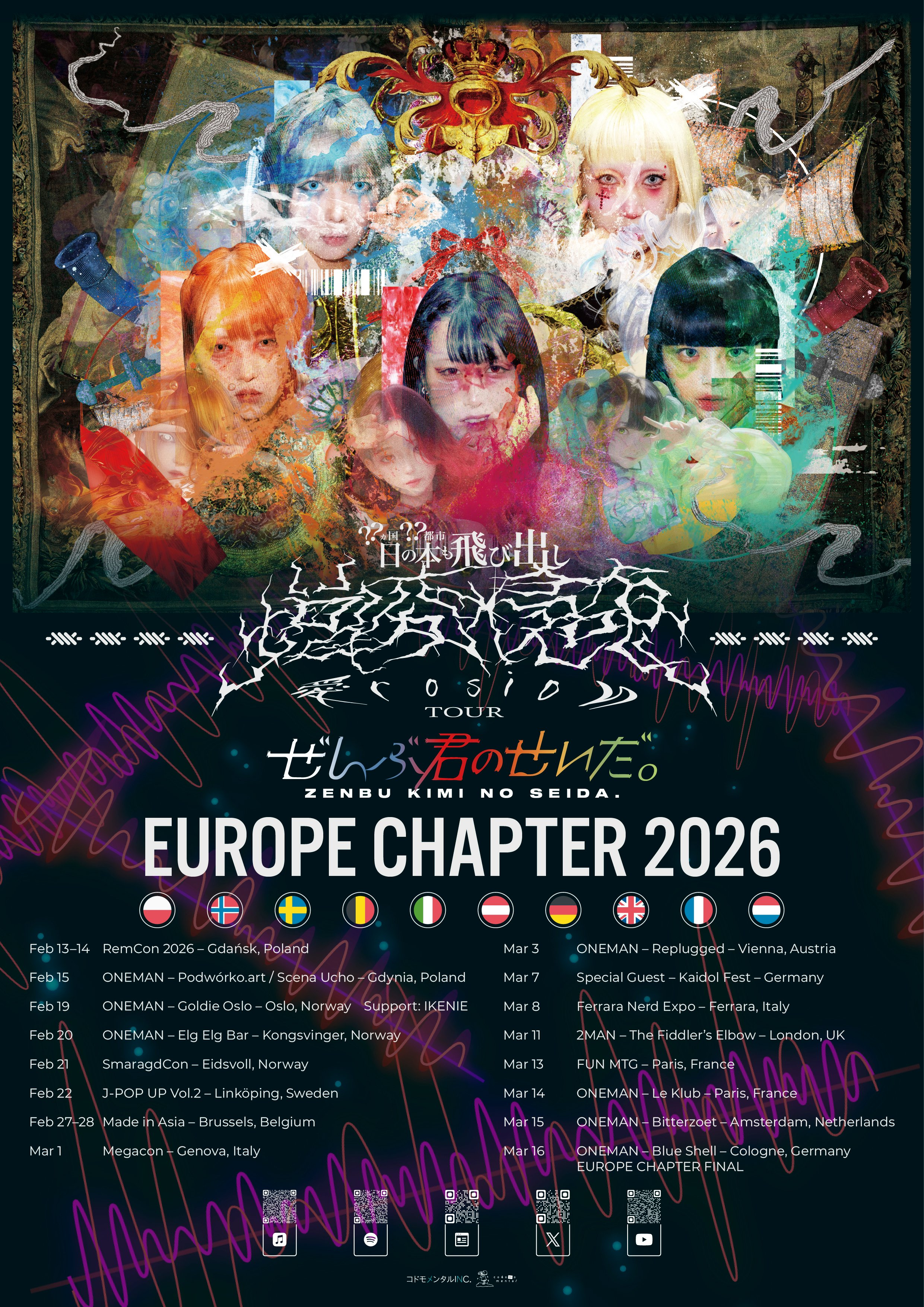
On February 22, 2026, something rare arrives in Linköping. J-POP UP Vol. 2 will transform Skylten into a living intersection of music, culture, and connection as Zenbu Kimi no Sei da. takes the stage in Sweden for the first time. J-POP UP is more than a concert — it is an immersive celebration of Japanese pop culture, where the boundary between stage and audience softens, and participation matters as much as performance.
📍 Skylten, Linköping
📅 February 22, 2026 | 13:00–19:00
🎟️ Tickets from 50 SEK via tickster.se
More information available via sjpa.se.
The Swedish stop forms part of a wider European run presented in collaboration with local promoters across the continent. Starting from March 13, 2026, the group will perform in France, Norway (1 / 2 / 3), Poland (1 / 2 / 3), Austria, Belgium (1 / 2), the Netherlands, and many more, with a grand finale in Germany (1 / 2). Each city becomes another point on the map where that promise unfolds — not as theory, but as shared heat in a room.
If this tour is about growth and transformation, then this is your invitation to witness it — not through a screen, but in person.