
On February 21 at midnight JST, Taisei Fukumoto will release the new digital single “Kimi ga Sabi” (君がサビ) ahead of his long-awaited 1st album angel wing, with the music video premiering the same day at 21:00 JST. It is an opening move that signals confidence: let the song speak first, let the hook land, and let the audience step into the world before the full project arrives.
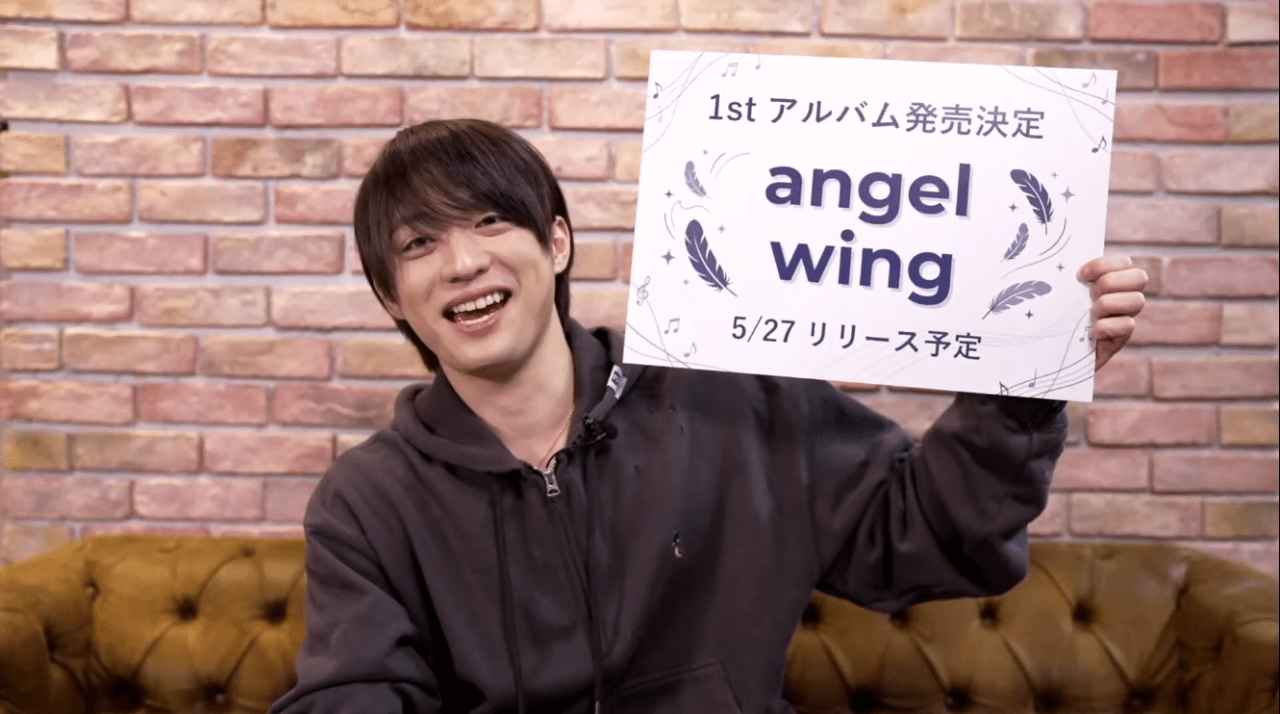
The title angel wing itself carries a layer of personal symbolism that goes far deeper than aesthetic imagery. In an earlier interview with Tokyohive, Taisei spoke about his so-called “angel wing” (tenshi no hane; 天使の羽) — the naturally silver patch of hair at the nape of his neck that stands out against the rest of his hair. He shared that he only became aware of it after joining the agency, when a hairdresser pointed it out to him. What could have been just a small physical detail instead turned into something meaningful, especially once fans began affectionately calling it his “angel wing.”
He revisited that story in greater depth during the recent livestream about the album, single, and tour announcement, revealing that he has actually had the silver streak since childhood. Over the years, some suggested he dye it or expressed concern about how much it stood out. But rather than viewing it as a flaw or a complex, he chose to see it as a unique point — a charm point. When fans lovingly named it his “angel wing,” he felt genuinely grateful. What might have been a source of self-consciousness instead became something embraced, something celebrated.


That perspective is central to the album’s identity. Rather than hiding what makes him different, Taisei frames it as an icon — one of the symbols that make up who “Taisei Fukumoto” is. He described angel wing as an album that he wants to become representative of his life, a first full-length work that carries not only songs, but his story and process. In his words, singles feel like presenting a finished track with impact — placing a song out into the world. An album, however, should carry the artist’s narrative. It should include the journey.
Because of that, angel wing is being constructed with deliberate range. He hinted that the final track count is still being finalized, but that it will include a substantial number of songs across multiple genres — each direction pushed to its fullest. Rather than staying safely within one sound, he aims to show the many facets of himself. It is an album built to let listeners experience “various versions of Taisei Fukumoto.”
He spoke with particular excitement about the demos, admitting that even in unfinished form, he has been listening to them daily. Many of the songs are collaborative works, but they have already become pieces he deeply loves — music he feels proud to stand behind. The confidence is clear. He repeatedly emphasized that this will be a representative work, a defining piece of his catalog, something he intends to refine until it fully embodies the standard he envisions.
In that sense, angel wing is not just named after a physical trait. It represents ownership — of individuality, of narrative, of growth. What began as a small silver streak noticed by others has transformed into a symbol chosen deliberately for a debut album. It carries gratitude toward the fans who named it, and determination toward the future he is building.

The new digital single, “Kimi ga Sabi,” translates literally to “You Are the Chorus,” a title that immediately reframes the usual dynamic between artist and listener. Rather than positioning himself as the center, Taisei places “you” at the emotional climax of the song. In pop structure, the chorus is the most memorable, most repeated, most emotionally charged section — the part everyone waits for. To call someone the chorus is to call them indispensable.
During the livestream, he revealed that the track was not originally intended to be positioned this prominently. It had initially been considered for a coupling slot, but once completed, its strength became undeniable. “This is a really good song,” he admitted with a laugh — the kind that signals genuine conviction rather than promotion. The decision to elevate it into a pre-release digital single was his own. If angel wing is meant to represent him fully, then “Kimi ga Sabi” became a natural frontrunner.
He described the song as highly listenable, easy to remember, and easy to sing — the kind of melody that lingers after one play. The title itself, he said, felt like something that “should have existed already” yet somehow didn’t — a phrase that made him think, “I found it.” That accessibility seems intentional. A chorus that invites participation is, by definition, communal. Just like how we fans feel when we look at Taisei and feel “I found you.“
The rollout reflects that spirit. Alongside the February 21 digital release at 0:00 JST and the 21:00 JST music video premiere, a digital campaign including pre-add, pre-save, Spotify Canvas features, and download initiatives will accompany the launch. It is a coordinated push, but one anchored in confidence. He repeatedly stated that he believes fans will absolutely like this song — not cautiously, but with certainty.
As for the music video, he hinted at a playful surprise. While he has released numerous songs and visuals before, this time viewers may find themselves thinking, “So this is this side of Taisei?” He described it as exciting and charming, suggesting a tone that expands rather than repeats what audiences have already seen.
In that context, “Kimi ga Sabi” does more than introduce the album — it sets the emotional temperature. It is both accessible and deliberate, catchy yet symbolic. And if the chorus belongs to the listener, then the stage is already being prepared for thousands of voices to sing it back to him.
The album angel wing is scheduled for release on May 27, marking Taisei’s official arrival with a cohesive body of work. A first album always carries weight. It gathers everything that led to this point — the trials, the growth, the recalibration — and compresses it into something tangible. The choice of imagery, the sequencing, the sonic palette: these decisions define how an artist wants to be understood moving forward.
But he is not stopping at a studio statement. angel wing will take flight across Japan with a nationwide tour of the same name in 2026, spanning 12 cities and 18 performances. Beginning on June 6 at SENDAI GIGS and moving through Yokohama, Niigata, Kanazawa, Kyoto, Kobe, Fukuoka, Takamatsu, Hiroshima, Nagoya, Osaka, and Tokyo’s Shibuya, the schedule reflects both reach and ambition. Multiple-day stops in Nagoya, Osaka, and Shibuya — including double performances — hint at expected demand and a desire to create moments that feel both expansive and personal.
A first tour built around a first album is more than promotion; it is a declaration of independence. Live stages test the material in real time. They reveal which songs become anthems, which ballads hush the room, which bridges draw the loudest call-and-response.
Fan club lottery applications open on February 21 at 19:00 JST and run through March 8 at 23:59 JST, marking the first opportunity for dedicated supporters to secure their place in this new era. The timing — digital single at 0:00, fan club applications that same evening — creates a carefully paced launch day: listen, watch, decide, commit.
Details about the album’s full tracklist and additional content are still to come, but the framework is already clear. angel wing is not being introduced quietly. It arrives with a pre-release anthem, a same-day music video premiere, a nationwide tour announcement, and a rollout that emphasizes connection as much as momentum.
For an artist stepping into his first album cycle, that clarity matters. Wings suggest ascent, but they also suggest balance — the need for something to hold you steady as you rise. With “Kimi ga Sabi,” Taisei Fukumoto seems to be saying that the steadying force is the listener. If the chorus is where a song truly lives, then this project may well be an invitation: don’t just watch the flight — become the refrain that carries it.
Taisei Fukumoto Official Links
More Taisei on Dumpling Box




Something went wrong. Please refresh the page and/or try again.