
On December 3, 2025, as nearly five thousand fans gathered inside Makuhari Event Hall, YouTube Fanfest Japan (YTFF) opened its twelfth chapter under a theme that felt almost too tender to be true: “Love Letter.”
A celebration of the unseen threads—algorithmic and emotional—that bind creators and fans together, the night unfolded like a collage of 2025’s brightest digital memories. From HIKAKIN & SEIKIN’s jubilant opening to AiScReam’s electric collaborations and the chaotic joy of the Creator Sports Festival, the festival pulsed with the energy of an internet that never stops reinventing itself.
And then, for the finale—Naniwa Danshi stepped into the light.
Their entrance wasn’t just a closing act. It felt like a reply to the year itself, a shimmering white envelope sealed with seven beating hearts.
Ever since their debut, Daigo Nishihata, Ryusei Onishi, Shunsuke Michieda, Kyohei Takahashi, Kento Nagao, Joichiro Fujiwara, and Kazuya Ohashi have carried Kansai brightness into the future of J‑Pop, offering a kind of optimism that doesn’t try to erase struggle but transforms it. Their YouTube channel—now followed by more than 1.9 million people—has become a living archive of that evolution: silly challenges, honest conversations, tiny rebellions of joy.
So when Daigo reflected during the talk segment, “We’ve grown these four years together with YouTube,” the room softened. It wasn’t nostalgia—it was acknowledgment. This was their first live stage at YTFF since their brief appearance in 2021, and they stood wrapped in pure white, sparkling brighter than any stars in the constellations, as if arriving to deliver a message they’d been writing for years.
They opened with “Beginner LOVE (UBU LOVE),” the debut track that once introduced the world to their innocence. A song that has long since crossed the line from debut milestone to cultural shorthand—a national anthem in its own right, the kind of melody that doesn’t just play but rises in the chest of everyone who’s ever loved them from the beginning.
And maybe the reason it still hits with the force of a first confession is that “Beginner LOVE (UBU LOVE)” has never really grown old. It carries the purity of a handwritten after‑school love letter, the kind that folds awkwardly but tenderly in your pocket. Its lyrics—simple, unabashed, almost embarrassingly honest—remind even the most grown‑up fan of a feeling they forgot they once had.
Each member’s voice slots into the arrangement like it was written for them before they ever stepped into a studio: Daigo’s crystalline sweetness, Ryusei’s glossy ad‑libs, Shunsuke’s straight‑arrow clarity, Kazuya’s warm embrace of a harmony. The signature gestures—the tiny heart, the shy hands to the cheeks, the chest‑pat of a racing pulse—aren’t just choreography; they’re a time capsule of what J‑Pop once promised and what Naniwa Danshi renewed: innocence not as naïveté, but as courage.
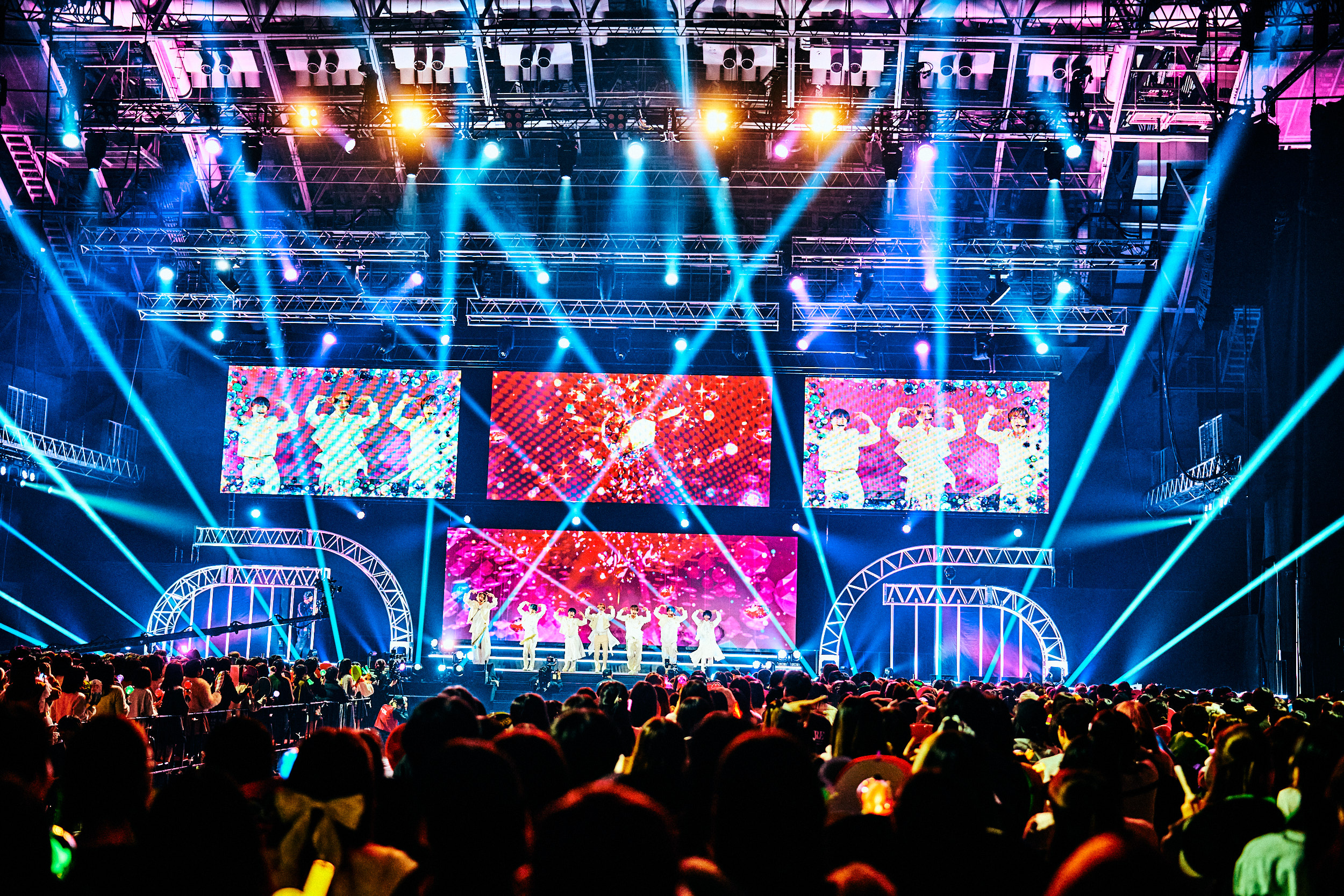
Even now, four years later, when “Beginner LOVE (UBU LOVE)” begins, the room doesn’t just cheer—it reverts, collapsing time until 2021 and 2025 feel indistinguishable. It’s a song that protects people’s first loves, however they define them. Perhaps that is its miracle.
Under swaying penlights, the seven moved in flawless unison, turning the hall into a whirlpool of unguarded youth.
Then came the Google Pixel CM song, “Hirahira × Tokimeki,” buoyed by Shunsuke’s clear, refreshing vocals and an off‑the‑cuff line from Joichiro that burst the room into laughter.
It begins with a title that feels like a dare: Hirahira, the flutter of butterfly wings; Tokimeki, the jolt of sudden love. Put together, it becomes a kind of emotional onomatopoeia—cute to the point of violence. The sound is sweet enough to melt enamel, and the monitors showed pictures of the members throughout the song, adding to the sweetness.
And woven into that sweetness is one of Naniwa Danshi’s quiet superpowers: the chorus choreography is easy enough for anyone in the audience to follow. The fluttering hands, the gentle waving motion, the soft bounce of the rhythm—each gesture is simple by design, crafted so that even a first‑time viewer can join in. It’s participatory magic, the kind that dissolves the distance between stage and seats. In those moments, you don’t just watch Naniwa Danshi; you move with them. It’s the connection they treasure most, spun into choreography that feels like an invitation rather than a performance. Thousands of hearts do not simply flutter—they flatline.
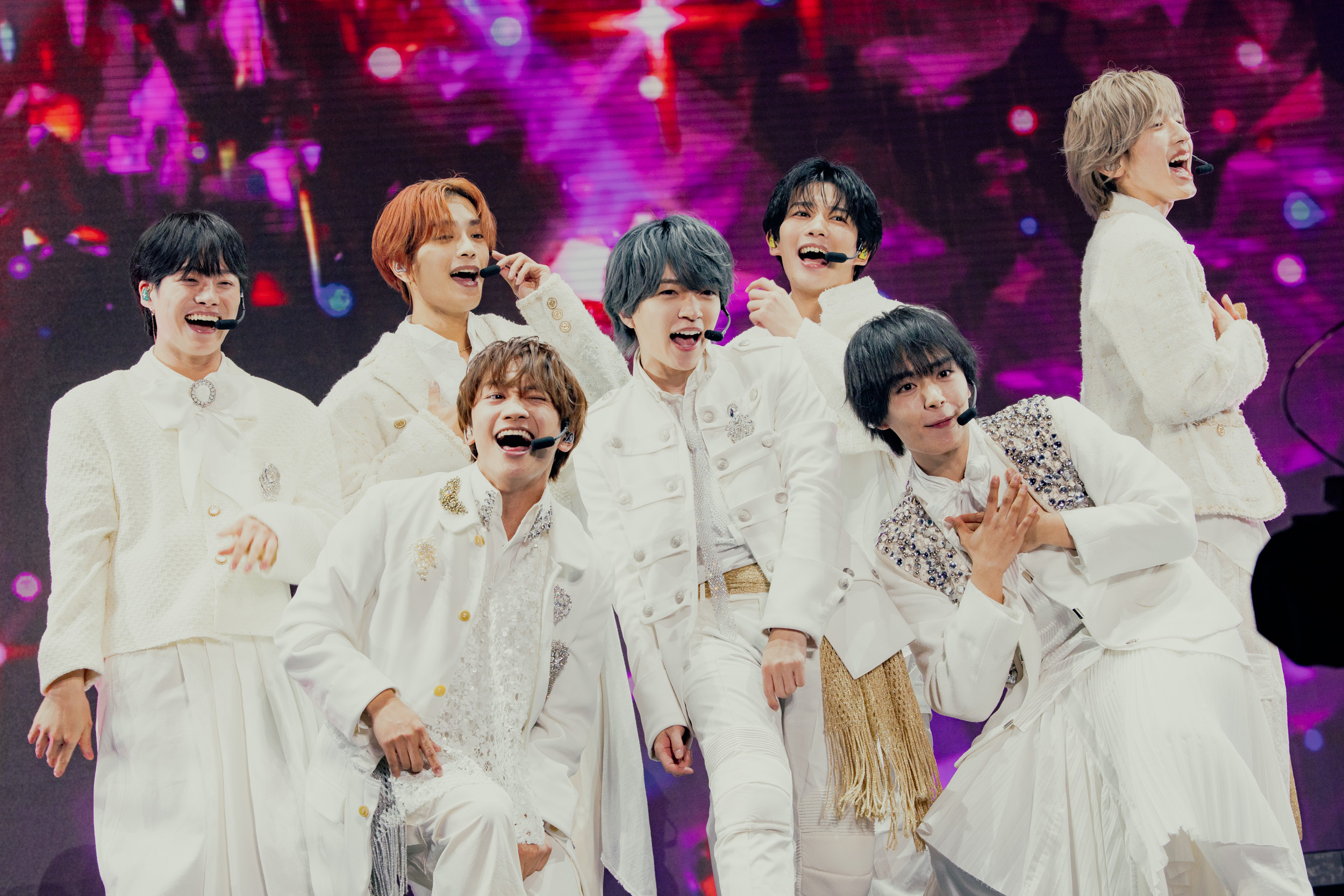
Released digitally on December 8, 2025, and tied to the film Romantic Killer starring Kyohei (with Joichiro also appearing), “Never Romantic” arrived not as a mere theme song but as a maxed-out love party tune. A miracle‑charged winter anthem, it exploded onto the scene with the bright, mischievous energy of a group that knows exactly how to turn romance on its head.
If “Beginner LOVE (UBU LOVE)” is pure first love and “Hirahira × Tokimeki” is eternal flutter, then “Never Romantic” is the reckless joy of giving in—a quintessential J-Pop love song that reminds the industry why Naniwa Danshi sit at the center of the national heartbeat.
Onstage, the track becomes something even bigger: a showcase of presence, charm, and the playful one-upmanship that defines them. Each member leans into the performance with a kind of competitive sweetness, as if silently asking the crowd, “Who’s the cutest tonight?” and knowing the real answer is always all seven of them at once.
If earlier songs sent the audience into emotional flatline, “Never Romantic” works like a defibrillator—zap, and you’re in love again. It leans back into the straightforward, glossy J-Pop romance that built the genre, especially compared to last year’s more mature and desaturated “Koisuru Hikari” or “Alpha.” But it’s far from childish. Instead, it carries a new maturity sharpened with a fresh, sparkling edge—an alchemy only Naniwa Danshi can pull off.
The night doubled as a SoftBank-sponsored stage, with Google Pixel woven into the performance. And if the songs were the emotional core of their appearance, the talk segment that followed was its pulse—messy, charming, and unmistakably them.
Onstage, the members slipped easily into their familiar rhythm: teasing each other, dissolving into laughter, and turning a corporate sponsorship into something that felt like a class reunion skit. Showing off the Google Pixel’s AI features, they transported themselves to Uyuni Salt Flats, and even reviewed a hilariously un‑idol‑like roller‑coaster face from an old YouTube vlog.
It was pure Naniwa: the kind of unscripted warmth that makes fans feel not like spectators, but accomplices in the joke. Their banter—Ryusei’s embarrassed laughter, Kento holding up the phone like a prized artifact, Joichiro‘s flustered complaints—sparked the kind of joy that no choreography could replicate. In those moments, the stage became a living extension of their channel, a reminder that their relationship with fans is built not just on performance, but on play. It was unexpectedly creative, proof that idol stages can dream bigger than their own borders.
But perhaps the loudest heartbeat came from their transformations. Daigo’s bright gray hair, Kazuya’s short black cut—small shifts, huge emotional shockwaves.
YTFF is ultimately a celebration of connection—of creators sending countless “love letters” to fans with every upload. Naniwa Danshi have embraced that idea, letting their channel become a diary they write with their whole selves. Their recent tour BON BON VOYAGE still echoes in fans’ memories, and with Tokyo Dome and Kyocera Dome concerts ahead in 2026—not to mention their successful Asia dates in Hong Kong, Taipei, and Seoul last year—their momentum feels unstoppable.
Yet their path has never been effortlessly smooth. The shift from the innocent glow of “Beginner LOVE (UBU LOVE)” to the layered mature freshness of “Never Romantic” maps a journey shaped by trust—trust in each other, trust in fans, trust in the quiet records YouTube keeps of every step forward. Daigo’s words lingered because they were true: YouTube didn’t just document their growth; it accelerated it.
Tonight’s stage felt like both a thank‑you note and an invitation.
A gratitude for the past four years. A promise for the next chapter.
As the final notes faded, the NaniFam community carried the warmth with them—waiting, already, for the next letter the boys will send. Imagining them once again bathed in white light at the 2026 dome shows is enough to make the heart ache in that sweet, familiar way. But this time, that hope stretches farther than any one venue.
Because YTFF wasn’t just a celebration of the past four years—it was a reminder of how far their reach has grown. Through YouTube, the borders that once kept fans apart have softened, even disappeared. Their Asia tour last year proved it. Hearts that once beat oceans away now move in sync with theirs, one upload, one performance, one shared moment at a time.
And maybe that’s the real magic of YouTube’s sprawling algorithm, that has, in its strange and serendipitous way, guided us toward them—and keeps guiding new fans every day. Toward seven boys who turned a stage into a story, and a story into something that belongs to all of us, everywhere.
Thank you, Naniwa Danshi. Your stage remains, always, a Love Letter tucked into the heart of 2025—and a promise that the world they’re building will only grow larger, brighter, and more connected from here.

Check out Naniwa Danshi on their various social media platforms!
Photos © YouTube.
More Naniwa Danshi on Dumpling Box




Something went wrong. Please refresh the page and/or try again.